

If you are on Suboxone and facing a workplace drug test, you are probably asking yourself a very reasonable question: will this cost me my job? Concerns about suboxone and work drug testing are real, and the fear of being penalized for a medication you take legally is stressful. The good news is that the rules around suboxone and employment explained through federal law are far more protective than most people realize. This article breaks down exactly how Suboxone shows up on drug tests, what your legal rights are, and how to handle every workplace testing scenario with confidence.
Table of Contents
- Key Takeaways
- Suboxone and work drug testing: what the panels actually screen for
- Your legal rights as an employee on Suboxone
- Navigating specific testing scenarios
- Handling an unexpected positive result for Suboxone
- My take on what no one tells you about this
- Support for patients at Mdmatt
- FAQ
Key Takeaways
| Point | Details |
|---|---|
| Standard panels miss Suboxone | Most DOT 5-panel tests do not screen for buprenorphine, so Suboxone rarely triggers a positive. |
| ADA protects MAT patients | Employers cannot deny you a job solely because you take lawfully prescribed Suboxone. |
| Expanded panels may detect it | Some non-DOT employers use 10 or 12-panel tests that do screen for buprenorphine. |
| MROs protect your privacy | Medical Review Officers verify your prescription before any result reaches your employer. |
| Document everything | Keeping records of your prescription and treatment protects you if a dispute arises. |
Suboxone and work drug testing: what the panels actually screen for
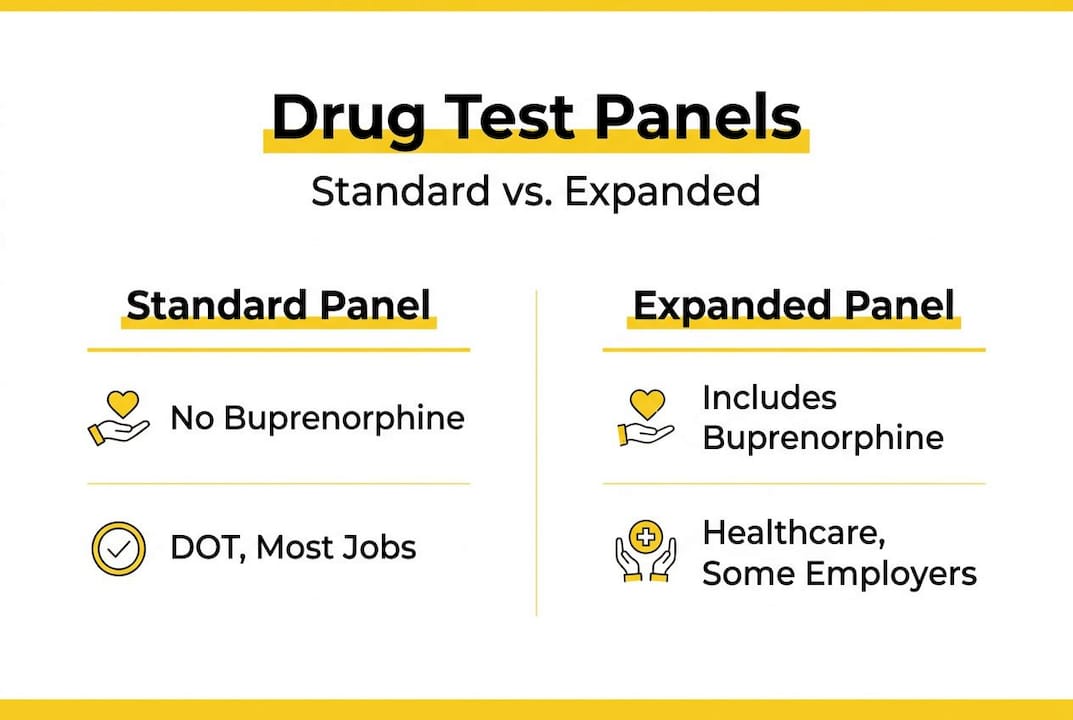
Most people assume that any drug test will catch any substance in their system. That is not how it works. Standard workplace drug tests are pre-configured panels that look for specific substances, and buprenorphine is excluded from the DOT’s standard 5-panel test.
Here is what the most common workplace drug panels actually screen for:
- DOT 5-panel: Marijuana (THC), cocaine, amphetamines, phencyclidine (PCP), and opioids such as heroin, codeine, and morphine. Buprenorphine is not on this list.
- Standard non-DOT 5-panel: Same basic categories as the DOT version in most cases. Suboxone still does not appear.
- Expanded 10 or 12-panel: This is where it gets more specific. Non-DOT employers may test for buprenorphine metabolites, meaning Suboxone can show up.
Understanding which panel your employer uses is honestly the most important piece of information you can have going into any test.
| Test Type | Includes Buprenorphine? | Who Uses It |
|---|---|---|
| DOT 5-panel | No | Federal contractors, transportation |
| Standard non-DOT 5-panel | No | Most general employers |
| 10-panel expanded | Sometimes | Healthcare, safety-sensitive roles |
| 12-panel expanded | Yes | Some private employers |
Detection windows also vary by testing method. In urine, buprenorphine is typically detectable for 3 to 7 days after your last dose. Hair follicle tests can flag it for up to 90 days. Saliva tests have a shorter window, usually 1 to 3 days. If you want a deeper look at how Suboxone behaves in your system over time, the Suboxone long-term effects resource from Mdmatt covers this in detail.
Pro Tip: Ask your HR department or the testing facility which specific panel your employer uses. You have every right to know what substances are being screened before you submit a sample.
Your legal rights as an employee on Suboxone
Federal law is clearly on your side here, and most employers either do not know that or choose not to advertise it. The Americans with Disabilities Act (ADA) is the centerpiece of your protection. Under the ADA, employers cannot discriminate against employees or job applicants who are lawfully taking Suboxone under medical supervision for opioid use disorder.
There are a few key specifics worth understanding:
- You are protected if your prescription is current and legitimate. Taking Suboxone as prescribed qualifies as lawful medication use, not illegal drug use.
- Employers must do an individualized assessment. They cannot apply a blanket policy that automatically disqualifies anyone on Suboxone. EEOC rulings specifically target blanket refusals as ADA violations.
- Safety-sensitive positions are a nuanced exception. If your job poses direct safety risks and your employer can show that Suboxone genuinely impairs your ability to perform it safely, that changes the calculus. But even then, individualized assessment is required, not a blanket ban.
- Your prescription is private. Employers are not entitled to your full medical history. The Medical Review Officer process exists specifically to protect that privacy.
The Medical Review Officer (MRO) role is worth understanding clearly. MROs are licensed physicians who act as intermediaries between the testing lab and your employer. If your test detects buprenorphine and you have a valid prescription, the MRO verifies your prescription and typically reports the result to your employer as negative. Your employer never sees that buprenorphine was present at all.
The law does not ask you to choose between your recovery and your career. What it asks is that you understand your rights well enough to exercise them.
Employers are also increasingly expected to build workplace wellness strategies that accommodate employees on lawful medications, which aligns with both ADA compliance and creating a healthier workforce overall.
Navigating specific testing scenarios
Knowing the rules in theory is one thing. Knowing exactly what to expect in each real-world testing situation is another. Here is how suboxone and workplace policy plays out across the most common testing contexts.
-
Pre-employment testing. If the employer uses a standard 5-panel test, your Suboxone almost certainly will not appear. If they use an expanded panel that includes buprenorphine, the MRO process protects you as long as your prescription is active. Before your test, confirm your prescription is current and that your prescribing physician can be reached quickly if the MRO needs verification.
-
DOT and safety-sensitive industries. Commercial drivers, airline staff, and federal contractors operate under DOT drug testing rules. The DOT 5-panel does not screen for buprenorphine, which means a standard DOT test will not flag your Suboxone. However, FMCSA regulations for commercial motor vehicle operators have their own medical certification process. The 2024 Medical Examiner’s Handbook now allows Suboxone patients to qualify after individualized risk assessments and physician statements, which reflects a meaningful shift in how regulators view medication-assisted treatment.
-
Random and post-accident testing. The same panel rules apply. If you are subject to random testing, knowing your employer’s panel type ahead of time gives you clarity rather than anxiety. Post-accident testing follows specific protocols, and directly observed collection may apply in return-to-duty scenarios to protect sample integrity.
-
Return-to-duty testing. This applies if you had a prior substance violation at work. These tests are often more rigorous and may involve observed collection. The MRO process still applies to protect your prescription information.
Pro Tip: Keep a printed or digital copy of your most recent Suboxone prescription on your phone or in your wallet when you know a drug test is coming. If the MRO needs to verify quickly, you can speed up the process significantly.
Understanding how Suboxone supports your recovery while you hold down employment is part of what Mdmatt addresses with patients directly. Reading about how Suboxone supports recovery can help you speak confidently about your treatment when it matters.
Handling an unexpected positive result for Suboxone
Even when you know the rules, an unexpected result can feel alarming. Here is what to do and what not to do.
- Do not panic or withdraw from the process. An initial positive is not a final result. It triggers the MRO review, not automatic termination.
- Contact your prescribing physician immediately. Let them know a drug test has flagged buprenorphine so they can be available to speak with the MRO if needed. Knowing how your prescription is renewed and kept current is part of staying prepared.
- Request a copy of the test result. You are entitled to know what substance was detected and at what level.
- Verify the MRO has your prescription documentation. If the MRO did not receive verification before reporting, that is a process failure you can challenge.
- Consult an employment attorney if your employer acts on an unverified result. Disciplinary action taken before the MRO review is complete may violate both ADA protections and the drug testing suboxone guidelines that govern your workplace.
Pro Tip: Keep a simple folder, physical or digital, that holds your prescription, your prescribing doctor’s contact information, and any correspondence about your treatment. This takes five minutes to set up and can protect you during a high-stress situation.
The biggest mistake people make is staying silent out of shame. You are taking a medically supervised medication. That is not something to hide from; it is something to communicate with appropriate documentation backing you up.

My take on what no one tells you about this
I have worked with enough patients to know that the fear of drug testing is one of the top reasons people delay starting Suboxone or stop taking it before they are ready. That is a serious problem. People are making decisions about life-saving medication based on misunderstandings about what drug tests actually screen for.
In my experience, most employers using standard panels will never see evidence of Suboxone. Most of the fear is based on assumptions, not on how employment drug screening suboxone rules actually work. The patients I see who stay informed, keep their prescriptions current, and understand the MRO process go through workplace testing without incident the vast majority of the time.
What I also see is that patients in safety-sensitive fields face a legitimately more complex situation, and they deserve honest guidance rather than false reassurance. If you drive commercially or work in a field with specific federal oversight, you need to understand both the testing rules and the FMCSA medical certification process. That conversation belongs with your treatment provider, not just a Google search.
My stronger piece of advice is this: do not let fear of a drug test keep you from staying on the medication that is helping you stay well. The law protects you. Your prescription protects you. The MRO process protects you. What puts you at risk is being unprepared, not being on Suboxone.
— Cory
Support for patients at Mdmatt
At Mdmatt’s Suboxone clinic, we work with patients every day who are managing opioid use disorder while staying active in their careers. We know that suboxone impact on employment is a real concern, and we take it seriously. Our team helps you maintain a properly documented, continuously updated prescription so you are always prepared if a workplace test arises. We also offer telehealth treatment services for patients who need flexible access to care around work schedules. If you have questions about how your treatment interacts with your employer’s drug testing policy, reach out to us. You deserve treatment that fits your life, not the other way around.
FAQ
Does Suboxone show up on a standard 5-panel drug test?
No. The standard DOT 5-panel drug test does not screen for buprenorphine, the active ingredient in Suboxone, so it will not produce a positive result on that panel.
Can an employer fire me for testing positive for Suboxone?
Generally, no. Under the ADA, employers cannot terminate or deny employment solely because you are lawfully prescribed Suboxone, and they must conduct an individualized assessment rather than apply a blanket policy.
What does a Medical Review Officer do with my Suboxone result?
The MRO contacts you and your prescribing physician to verify your prescription. If it is confirmed, the MRO typically reports the result to your employer as negative, protecting your privacy.
What if my employer uses an expanded drug panel that tests for buprenorphine?
Your prescription still protects you through the MRO process. Keep your prescription current and your prescribing physician’s contact information accessible so verification can happen quickly.
Are DOT commercial drivers allowed to use Suboxone?
DOT 5-panel tests do not test for buprenorphine, but FMCSA commercial driver certification involves a separate medical evaluation. Under the 2024 Medical Examiner’s Handbook, Suboxone patients may qualify after an individualized risk assessment and physician documentation.

