

If you’ve heard that Suboxone is “just another opioid,” you’re not alone in that misunderstanding. The suboxone partial opioid agonist explained concept sits at the heart of why this medication works so differently from the drugs it treats. Suboxone contains buprenorphine, a partial opioid agonist that activates your brain’s opioid receptors in a controlled, limited way. That distinction is not a small detail. It changes how safe the medication is, how much potential it has for misuse, and why doctors prescribe it specifically to treat opioid use disorder rather than simply replace one dependency with another.
Table of Contents
- Key Takeaways
- How Suboxone’s partial opioid agonist mechanism works
- Why partial agonism makes Suboxone safer in treatment
- Suboxone vs full agonists: how they compare
- What patients and caregivers often miss
- My take on why this knowledge changes everything
- Start your Suboxone treatment with real support
- FAQ
Key Takeaways
| Point | Details |
|---|---|
| Partial agonism limits effects | Buprenorphine activates opioid receptors partially, creating a ceiling on euphoria and respiratory depression. |
| Naloxone deters misuse | The naloxone in Suboxone blocks opioid effects if the medication is injected, reducing diversion risk. |
| Safer than full agonists | Buprenorphine carries a significantly lower overdose risk than methadone or heroin due to its ceiling effect. |
| Induction timing matters | Starting Suboxone too early can trigger precipitated withdrawal; medical supervision during induction is critical. |
| Medication alone is not enough | Buprenorphine works best when paired with counseling and a personalized treatment plan. |
How Suboxone’s partial opioid agonist mechanism works
To understand how Suboxone works, you first need a clear partial agonist definition. Opioid receptors in your brain have a locking mechanism. Full agonists, like heroin or methadone, turn that lock all the way and produce a maximal response. Partial agonists, like buprenorphine, only turn the lock partway. The door opens, but not all the way.
This partial activation matters in two specific ways. First, buprenorphine has high receptor affinity and partial activation, meaning it binds tightly to mu-opioid receptors but stimulates them submaximally. It essentially holds the receptor occupied while limiting how much stimulation gets through. Second, because it binds so tightly, it can actually block full agonists from taking effect, acting almost like an antagonist when other opioids are present.
Here is what this means in practical terms for the suboxone mechanism of action:
- Euphoria is blunted. Buprenorphine does produce some opioid effects at certain doses, but weaker than full agonists like methadone and heroin, making recreational misuse far less appealing.
- Respiratory depression plateaus. Unlike full agonists, where higher doses keep increasing the risk of dangerously slow breathing, buprenorphine hits a ceiling. Breathing risk does not keep climbing with the dose.
- Withdrawal symptoms are suppressed. Because the receptors are still being activated, someone in opioid use disorder does not go into acute withdrawal while on Suboxone.
- Cravings are reduced. Stable, low-level receptor activity throughout the day removes the sharp peaks and crashes that drive craving cycles.
The naloxone component adds another layer of protection. Naloxone reduces diversion by blocking opioid effects if someone tries to inject the medication. When taken as prescribed under the tongue, the naloxone is barely absorbed into the bloodstream. If someone injects it, the naloxone activates fully and immediately blocks or reverses opioid effects. You can read more about why both ingredients matter in Mdmatt’s treatment guide.
Pro Tip: If you or someone you care for is starting Suboxone, understanding that buprenorphine is supposed to keep you stable, not high, can shift your expectations in a way that dramatically improves treatment outcomes.
Why partial agonism makes Suboxone safer in treatment
Understanding opioid agonists is one thing. Understanding why partial agonism specifically makes Suboxone a preferred treatment option is another. The ceiling effect is the defining safety feature. Beyond a certain dose, increasing buprenorphine does not produce more respiratory depression. That does not mean it is risk-free, but it does mean the safety window is far wider than with full agonists.
Here is how the clinical picture plays out step by step for someone beginning Suboxone therapy:
- Induction begins in mild-to-moderate withdrawal. Starting Suboxone before withdrawal begins is dangerous because buprenorphine’s high receptor affinity can displace whatever full agonist is still on the receptors, causing sudden precipitated withdrawal.
- Day 1 dosing is conservative. Typical Day 1 dosing ranges from 4.2 to 8.4 mg of buprenorphine, calibrated to prior opioid use to avoid triggering severe withdrawal.
- Doses increase carefully on Day 2. Day 2 maximums typically reach 8.4 to 16 mg depending on the patient’s history, allowing the body to stabilize.
- A maintenance dose is established. Once stabilized, patients take a consistent daily dose that suppresses withdrawal and cravings without producing significant euphoria.
- Medical supervision remains ongoing. Because buprenorphine can still produce opioid effects at certain doses, ongoing provider oversight is not optional. It is a core part of what makes the treatment safe.
“Buprenorphine is most effective as part of a comprehensive treatment plan that balances medication with counseling and support.” — SAMHSA
One piece that patients and caregivers often misunderstand is why naloxone is included at all. Many people assume it is there for overdose emergencies, the same way a naloxone kit might be used on the street. That is partly true, but the primary role of naloxone in Suboxone is misuse deterrence. When the medication is used as directed, the naloxone component barely does anything. The protection it provides is specifically triggered by injection misuse, which is a clever pharmacological design built around reducing street diversion. Knowing this removes a lot of unnecessary fear about the medication.
Suboxone vs full agonists: how they compare
When people research options for treating opioid use disorder, the most common comparison is between Suboxone and methadone. Both are effective. They work very differently, and those differences shape who benefits most from each.
| Feature | Suboxone (Buprenorphine/Naloxone) | Methadone | Naltrexone |
|---|---|---|---|
| Agonist type | Partial agonist | Full agonist | Antagonist (no agonism) |
| Overdose risk | Lower due to ceiling effect | Higher; no ceiling effect | Low; blocks opioid effects |
| Prescribing setting | Office-based; telehealth eligible | Requires specialized clinic daily | Office-based |
| Euphoria potential | Low to moderate | Higher | None |
| Withdrawal suppression | Yes | Yes | No (may worsen if opioids remain) |
| Misuse deterrent | Yes (naloxone) | No | Yes (blocks effects) |
Methadone is a full mu-opioid agonist that produces maximal receptor activation. It is effective for many patients, especially those with very high tolerance or complex histories. The tradeoff is that it carries a higher overdose risk and requires daily visits to a federally regulated clinic, at least initially. That clinic requirement creates real barriers for people who work, have children, or live in rural areas.
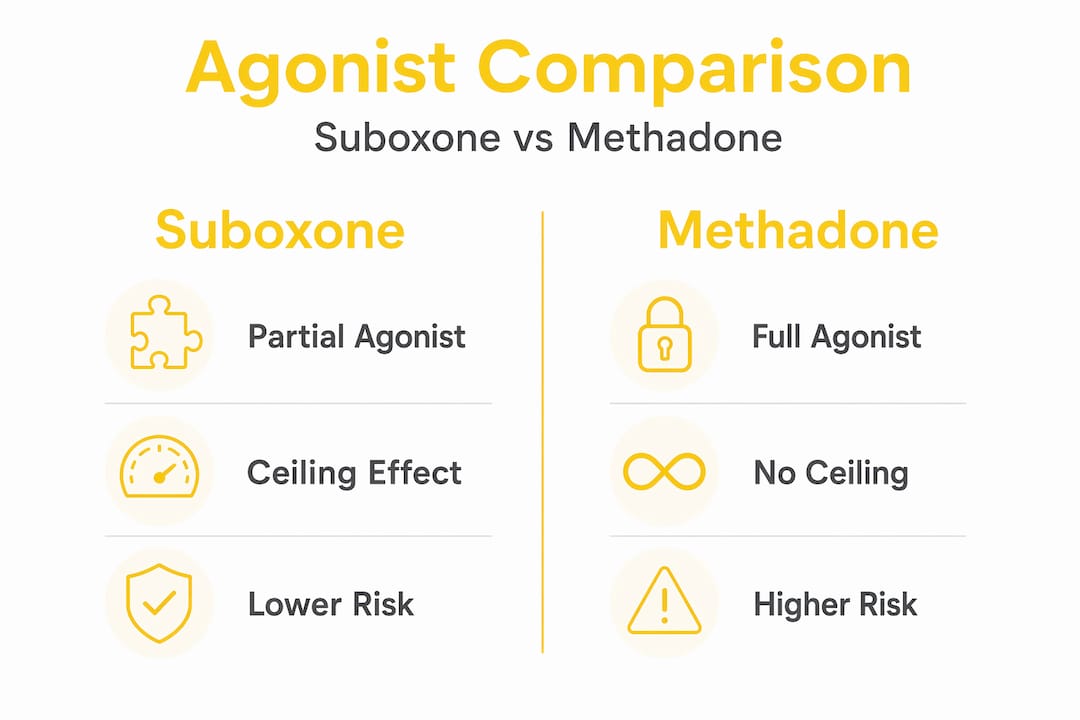
Suboxone’s partial agonism changes the access picture significantly. Because the ceiling effect limits overdose risk, qualified physicians can prescribe it in outpatient office settings and through telehealth. That flexibility is not just convenient. For many patients, it is the difference between being able to pursue treatment or not.

Naltrexone, the third major option, is an opioid antagonist with no agonist activity at all. It blocks opioid receptors completely and is a strong option for patients who are already fully detoxed and highly motivated. The challenge is that it requires a patient to be completely opioid-free before starting, which can be a significant barrier during early recovery.
When considering suboxone vs full agonists, the benefits of suboxone therapy consistently include greater accessibility, a safer overdose profile, and a built-in misuse deterrent. That combination makes it the most widely prescribed medication for opioid use disorder in outpatient settings today.
What patients and caregivers often miss
The pharmacology explains the “what.” What follows covers the “what now” for people actually going through treatment or supporting someone who is.
Dosing is not one-size-fits-all. Your starting dose and maintenance dose will reflect your history with opioids, how much you were using, and how your body responds. You can learn more about why your dose varies and what drives those decisions in treatment.
A few things that often catch patients and caregivers off guard:
- Dental health needs attention. Suboxone dissolves under the tongue and can contribute to dry mouth and tooth decay over time. Rinsing with water after each dose and maintaining regular dental visits are simple protections worth taking seriously.
- Suboxone is not a shortcut out of addiction. The medication stabilizes the biology. The work of addressing why opioid use started, through counseling and support, is what builds lasting recovery. Comprehensive care plans that combine both medication and support give people the best outcomes.
- Naloxone will not hurt you if you take the medication as prescribed. Many patients worry unnecessarily about this. When Suboxone is used sublingually as directed, the naloxone is minimally absorbed and causes no significant effect.
- Precipitated withdrawal is preventable. The most common early mistake is starting Suboxone before you are in sufficient withdrawal from your previous opioid. Your prescriber will guide you through the timing. Trusting that process protects you from a very uncomfortable experience.
Pro Tip: Caregivers supporting a loved one in Suboxone treatment can make a real difference by learning the basics of how the medication works. When family members understand the difference between physical dependence and addiction, they tend to provide support that actually helps instead of unintentionally adding shame.
My take on why this knowledge changes everything
I’ve worked with patients and families navigating opioid use disorder long enough to notice a consistent pattern. The people who truly understand how Suboxone works as a partial opioid agonist are the ones who stick with treatment. Not because knowledge fixes everything, but because clarity removes fear and shame that quietly undermine recovery from the inside.
I’ve sat with patients who stopped taking Suboxone because a family member told them they were “still on drugs.” That misunderstanding, rooted in not knowing the difference between a partial agonist and a full agonist, can end someone’s best chance at recovery. The science is not complicated once you frame it right. Buprenorphine keeps the brain stable the way blood pressure medication keeps the heart stable. You would not tell someone to stop their antihypertensive because it “still affects your body.”
What I’ve also learned is that the medication is one part of a larger picture. The patients who rebuild their lives most fully are the ones whose treatment addresses the root causes: the pain, the trauma, the circumstances that made opioid use feel like the only relief available. Medication gives them the stability to do that deeper work. It does not do that work for them.
My honest take is that every person considering Suboxone deserves to walk into their first appointment already knowing what a partial agonist is and why it matters. That knowledge belongs to the patient, not just the provider.
— Cory
Start your Suboxone treatment with real support

At Mdmatt, we believe that understanding your medication is part of your care. Our Suboxone treatment clinic offers individualized medication-assisted treatment built around your history, your goals, and your life. We do not apply a one-size-fits-all approach because opioid use disorder is not a one-size-fits-all condition.
Whether you are newly considering treatment or you have questions about how your current plan is working, our team is here to walk through it with you. We also offer telehealth treatment services for patients who need flexible access from home, and individual counseling to address the underlying challenges that often sit beneath opioid use disorder. Reaching out is not a commitment to anything except learning more. You deserve care that treats you with dignity from the very first conversation.
FAQ
What does “partial opioid agonist” mean?
A partial opioid agonist binds to opioid receptors but activates them only partially, producing weaker effects than full agonists like heroin or methadone. This partial activation creates a ceiling on effects like euphoria and respiratory depression.
Why is Suboxone safer than methadone for overdose?
Buprenorphine’s ceiling effect means that increasing the dose beyond a certain point does not continue to increase respiratory depression, making accidental fatal overdose far less likely than with full opioid agonists like methadone.
What does naloxone actually do in Suboxone?
Naloxone is primarily a misuse deterrent. When Suboxone is taken as directed under the tongue, the naloxone has little effect. If someone injects it, naloxone blocks opioid effects and can trigger immediate withdrawal, which discourages injection misuse.
What is precipitated withdrawal and how is it avoided?
Precipitated withdrawal happens when buprenorphine displaces full agonists from receptors before the body is ready, causing sudden severe withdrawal. It is avoided by timing induction carefully and starting Suboxone only after mild to moderate withdrawal symptoms have already begun.
Can you get high on Suboxone?
Buprenorphine does produce some opioid effects at lower doses, but effects are significantly weaker than full agonists. At therapeutic maintenance doses, euphoria is minimal, which is one reason Suboxone is preferred for long-term opioid use disorder treatment.

