

Starting Suboxone (buprenorphine/naloxone) is one of the most effective steps you can take toward recovery from opioid use disorder. But avoiding Suboxone precipitated withdrawal, the clinical term is “buprenorphine-precipitated withdrawal,” is something every patient and provider must get right. When Suboxone is taken too soon after your last opioid use, it can trigger sudden, intense withdrawal symptoms that feel far worse than standard withdrawal. That experience can shake your confidence and, in some cases, push people away from treatment entirely. This guide explains exactly why it happens, how to prepare, and what to do to give yourself the best possible start.
Table of Contents
- Key Takeaways
- Avoiding Suboxone precipitated withdrawal: causes and warning signs
- How to prepare before starting Suboxone
- Step-by-step guide to starting Suboxone safely
- What to do if precipitated withdrawal occurs anyway
- What a smooth induction means for your recovery
- My perspective on what actually works at induction
- Start your Suboxone treatment with the right support
- FAQ
Key Takeaways
| Point | Details |
|---|---|
| Timing is everything | Wait until moderate withdrawal signs appear, at least 12 to 24 hours after your last opioid use, before taking your first dose. |
| Fentanyl changes the rules | Fentanyl stays in tissue much longer than other opioids, making standard timing guidelines unreliable and low-dose induction more appropriate. |
| COWS score guides readiness | A Clinical Opiate Withdrawal Scale score of 8 to 12 or higher signals you are ready to begin Suboxone safely. |
| Support reduces risk significantly | Clinical or social support during induction lowers the rate of precipitated withdrawal meaningfully compared to going it alone. |
| Recovery is possible after setbacks | If precipitated withdrawal does occur, it is manageable and does not mean treatment has failed. |
Avoiding Suboxone precipitated withdrawal: causes and warning signs
To protect yourself, you first need to understand what is actually happening in your body. Buprenorphine is a partial opioid agonist with an extremely high affinity for the opioid receptors in your brain. That means it attaches to those receptors more strongly than full agonists like heroin, oxycodone, or fentanyl. When full agonists are still occupying your receptors and buprenorphine is introduced, it rapidly displaces them. Because buprenorphine only partially activates those receptors, the sudden shift can send your nervous system into shock. Moderate withdrawal signs must be present before starting treatment to prevent this from happening.
The risk increases significantly with methadone or other long-acting opioids. Methadone, for instance, has a much longer half-life than short-acting opioids, which means it stays active in your system well beyond 24 hours. For patients on higher methadone doses (above 30 mg), starting buprenorphine too soon dramatically increases the chance of triggering acute withdrawal.
Fentanyl adds another layer of complexity. Unlike heroin or prescription opioids, fentanyl and its analogs accumulate in fat tissue and release slowly back into the bloodstream over days. This means your body may still have active opioids on board even when you feel like you are in withdrawal.
Symptoms of precipitated withdrawal typically appear 30 to 90 minutes post-dose and can include:
- Sudden, severe nausea or vomiting
- Intense muscle cramping and body aches
- Profuse sweating and chills
- Rapid heart rate and anxiety
- Severe agitation and restlessness
- Diarrhea
These symptoms are more abrupt and more intense than regular opioid withdrawal. If you notice any of these within an hour or two of your first dose, precipitated withdrawal should be your first concern.
How to prepare before starting Suboxone
Preparation is where preventing Suboxone withdrawal truly begins. The most important step you can take is giving your body enough time to clear the opioids from your receptors before your first dose.
For short-acting opioids like heroin, oxycodone, or hydrocodone, most guidelines recommend waiting at least 12 to 24 hours after your last use. For methadone, waiting more than 24 hours is standard, and your prescriber may recommend waiting significantly longer depending on your dose. For fentanyl, there is no single reliable timeframe, which is why many providers now favor specialized induction methods.
The following table outlines typical waiting periods by opioid type:
| Opioid type | Minimum wait before first dose | Notes |
|---|---|---|
| Short-acting (heroin, oxycodone) | 12 to 24 hours | Wait for moderate withdrawal signs |
| Long-acting (methadone) | More than 24 hours | Longer if dose was above 30 mg daily |
| Fentanyl and analogs | Variable, often 24 to 72+ hours | Low-dose induction strongly recommended |
| Extended-release formulations | 36 to 48+ hours | Consult your provider for specific guidance |
Your clinical team will likely use the Clinical Opiate Withdrawal Scale (COWS) to assess your readiness. This is a structured scoring tool that measures signs like pulse rate, sweating, tremor, yawning, and anxiety. COWS monitoring during induction enables early detection of precipitated withdrawal and guides timely responses. You want to score at least 8 to 12 before your first dose.
Pro Tip: Do not try to “push through” mild discomfort and take your dose too early. Being uncomfortable is not the same as being ready. A COWS score in the moderate range is your green light, not just the passage of time.
If you are transitioning from methadone specifically, you may want to read about the differences between Suboxone and methadone to better understand why your induction timeline may be longer and why careful supervision matters so much.
Research makes clear that outpatient inductions without support result in a higher rate of precipitated withdrawal. Specifically, 67% of self-reported precipitated withdrawal cases occurred in people who started without clinical or social support. Having a care team behind you is not just emotionally helpful. It is clinically protective.

Step-by-step guide to starting Suboxone safely
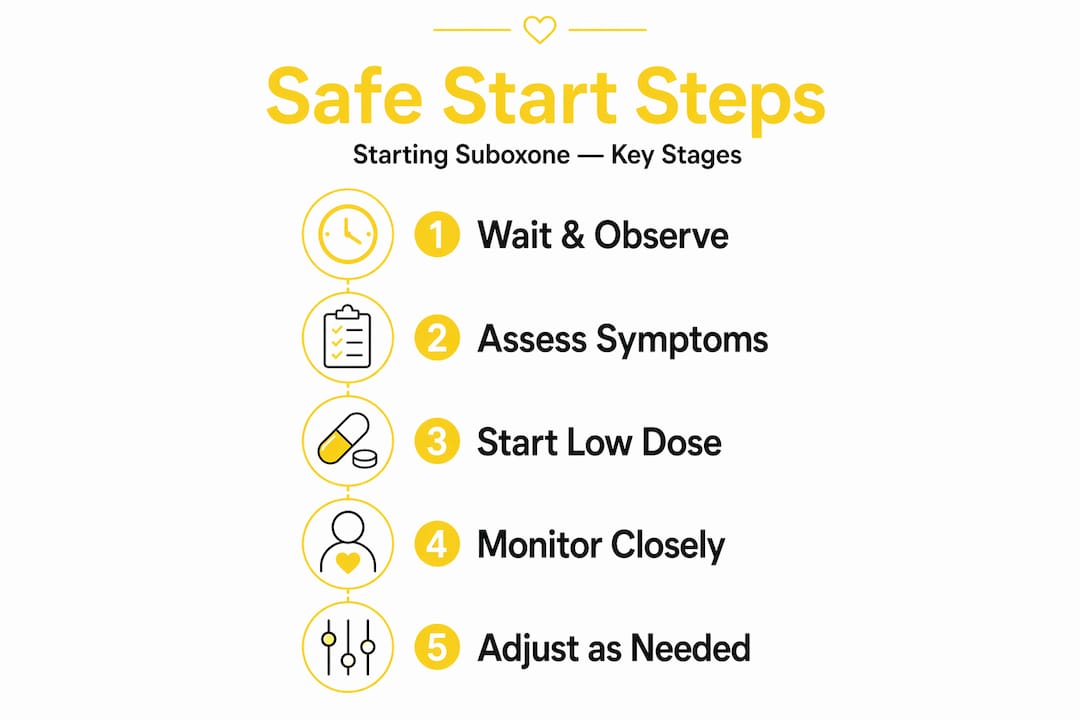
Following a clear sequence of steps dramatically reduces your risk of a difficult experience at induction.
- Confirm your last opioid use. Be completely honest with your provider about what you used, how much, and exactly when. There is no judgment here. Accurate information helps your team protect you.
- Wait for moderate withdrawal symptoms. Use your COWS score as a guide, not the clock alone. Moderate withdrawal means your receptors are clearing and your body is ready to respond appropriately to buprenorphine.
- Start with a low first dose. Most protocols begin at 2 mg to 4 mg, not a full daily dose. This allows your care team to watch how you respond before increasing.
- Consider low-dose induction (LDI) if you have used fentanyl. Also called the Bernese method, LDI involves starting with a very small amount of buprenorphine and increasing gradually over several days, even while still experiencing some opioid effects. LDI protocols show real promise for patients with fentanyl exposure: 68.8% reported the approach effective, and 75% said they would use it again.
- Stay monitored for at least two to four hours after your first dose. Whether in a clinic or via telehealth check-in, do not take your first dose and disappear. Your care team needs to know how you feel.
- Report any worsening symptoms immediately. Mild discomfort is expected. But if symptoms escalate rapidly within the first hour or two, contact your provider right away.
Pro Tip: If you have been using fentanyl regularly, bring this up directly with your provider before induction day. Ask about low-dose induction specifically. It could be the single most important conversation you have before starting treatment.
The table below compares traditional induction with low-dose induction:
| Factor | Traditional induction | Low-dose induction (LDI) |
|---|---|---|
| Starting dose | 2 to 4 mg on day of moderate withdrawal | 0.5 mg or less, gradually increasing |
| Timing requirement | Strict pre-induction abstinence | Less dependent on full opioid clearance |
| Best suited for | Short-acting opioid users | Fentanyl users or complex cases |
| Risk of precipitated withdrawal | Moderate if timing is off | Lower with proper clinical follow-up |
Learning more about how to start Suboxone safely can help you feel prepared and confident going into your first appointment.
What to do if precipitated withdrawal occurs anyway
Despite careful preparation, precipitated withdrawal has an incidence of about 6.7% even in supervised settings. If it happens to you, it does not mean you did anything wrong. It means you need a different strategy, not that you should give up on treatment.
The most critical first step is distinguishing between buprenorphine-precipitated withdrawal and undertreated regular withdrawal. Knowing the difference determines whether your provider should pause buprenorphine, adjust the dose, or add supportive medications. These two conditions require very different clinical responses.
Here is what you and your care team can do if precipitated withdrawal begins:
- Do not take more buprenorphine immediately. Adding more of the same medication that triggered the reaction is rarely the right move without provider guidance.
- Contact your provider or treatment center right away. Describe your symptoms, when they started, and how severe they are. Your care team can guide you through next steps in real time.
- Supportive medications can help. Clonidine, ondansetron, and other medications can ease specific symptoms like sweating, nausea, and agitation while your system stabilizes.
- Stay hydrated and rest. Precipitated withdrawal is miserable but it does pass. Keeping fluids in your body and reducing stimulation helps.
- Follow up with your provider to revise your induction plan. After the episode resolves, your team should reassess your opioid history, consider LDI, and create a more tailored approach.
You are not starting over. You are gathering information that makes your next attempt smarter and safer.
What a smooth induction means for your recovery
When induction goes well, it sets the tone for everything that follows. Suboxone that is introduced at the right time, in the right way, significantly reduces cravings and helps prevent relapse. You are able to think more clearly, sleep better, and engage with counseling in a way that is much harder when your body is in crisis.
Ongoing clinical support and behavioral counseling compound that benefit. Medication alone addresses the physical dimension of opioid use disorder, but recovery is about your whole life, including relationships, mental health, work, and self-worth. At Mdmatt, the team works alongside you on those deeper factors.
Pro Tip: Once your dose is stable and you feel physically steady, prioritize getting connected with a counselor. The medication holds the door open. Counseling helps you walk through it.
My perspective on what actually works at induction
I have worked with patients navigating Suboxone inductions across a wide range of circumstances. And what I keep coming back to is this: timing guidelines are necessary but they are not sufficient on their own, especially now that fentanyl dominates the opioid supply.
I have seen patients follow the 24-hour rule carefully and still experience precipitated withdrawal because fentanyl was still releasing from tissue. The textbook answer did not fit their actual situation. That is why I believe low-dose induction is not a niche option anymore. It deserves serious consideration for most patients who have been using illicit opioids in 2026.
The other thing I want to be honest about is fear. Many patients come to induction with serious anxiety about precipitated withdrawal. Some have heard horror stories. That fear sometimes leads people to avoid starting treatment altogether. But the research tells us that patients without structured support have far worse outcomes at induction. Fear is understandable. Letting it keep you from a treatment team is the real risk.
What I find works best is a combination of three things: a provider who takes your full substance use history seriously, a plan tailored to your specific opioid history rather than a generic protocol, and at least one person in your corner on induction day. That could be a counselor, a peer recovery specialist, or a trusted family member. You do not have to do this alone, and you should not have to.
— Cory
Start your Suboxone treatment with the right support
Taking the first step toward Suboxone treatment is brave, and you deserve a team that makes that step as safe and smooth as possible.

At Mdmatt, medically supervised Suboxone inductions are a cornerstone of care. The clinical team guides you through every stage, from assessing your withdrawal readiness to choosing the right induction method for your specific opioid history. For patients who cannot easily come in person, telehealth treatment options make it possible to get expert support from where you are most comfortable. Whether you are just exploring treatment or ready to start today, the Suboxone treatment clinic at Mdmatt is here to help you begin with confidence and clinical backup.
FAQ
What causes precipitated withdrawal from Suboxone?
Precipitated withdrawal occurs when buprenorphine displaces full opioid agonists from your receptors before they have cleared your system. Because buprenorphine only partially activates those receptors, the rapid displacement causes sudden, severe withdrawal symptoms.
How long should you wait before taking your first Suboxone dose?
For short-acting opioids, wait at least 12 to 24 hours and until moderate withdrawal signs appear. FDA guidance recommends waiting longer for methadone users, especially those on doses above 30 mg daily.
What is low-dose induction and who needs it?
Low-dose induction (LDI) involves starting buprenorphine at very small amounts and increasing gradually, making it ideal for people who have used fentanyl. LDI has proven effective for reducing precipitated withdrawal risk in fentanyl-prevalent populations.
How do you know if you are experiencing precipitated withdrawal or regular withdrawal?
Precipitated withdrawal typically starts 30 to 90 minutes after your first buprenorphine dose and feels more sudden and intense than regular withdrawal. Regular withdrawal builds gradually over hours to days rather than spiking shortly after medication.
Can you still recover if precipitated withdrawal happens?
Yes. Precipitated withdrawal is manageable with supportive care and does not mean treatment has failed. Your provider can revise your induction plan and, in many cases, a tailored approach on the next attempt leads to a successful start.

