

Recovery is not simply a matter of wanting it badly enough. If you or someone you love is working through opioid use disorder or another substance use challenge, you already know that willpower alone tells only a fraction of the story. What is recovery capital? It is the total set of internal and external resources a person can draw on to start and sustain recovery. This concept reframes the entire conversation, shifting focus from what someone lacks to what they already have and what they can build. Understanding it is one of the most practical things you can do right now.
Table of Contents
- Key takeaways
- What is recovery capital: definition and core domains
- Measuring recovery capital in research and practice
- How recovery capital shapes real recovery outcomes
- How to build recovery capital: practical strategies
- Common misconceptions about recovery capital
- My perspective on why this framework changes everything
- How Mdmatt supports your recovery capital
- FAQ
Key takeaways
| Point | Details |
|---|---|
| Recovery capital is a framework | It measures all resources that help a person start and maintain long-term recovery. |
| Four core domains exist | Social, physical, human, and cultural capital each play a distinct role in recovery success. |
| It is measurable | Validated tools like the MIRC and RCI help clinicians and individuals track strengths and gaps. |
| Negative capital creates real risk | Barriers like stigma and poverty increase relapse risk and must be addressed alongside strengths. |
| You can actively build it | Targeted actions across each domain compound over time into a stronger recovery foundation. |
What is recovery capital: definition and core domains
The formal definition of recovery capital traces back to researchers Robert Granfield and William Cloud, who coined the concept in the late 1990s. They described it as the breadth and depth of internal and external resources a person can use to initiate and sustain recovery from addiction. That definition remains the foundation of the field today.
What made this framework significant was not just the definition itself. It was the direction it pointed clinicians and patients toward. Instead of cataloging everything someone had lost or broken, recovery capital asked a different question: What do you have, and what can you grow?
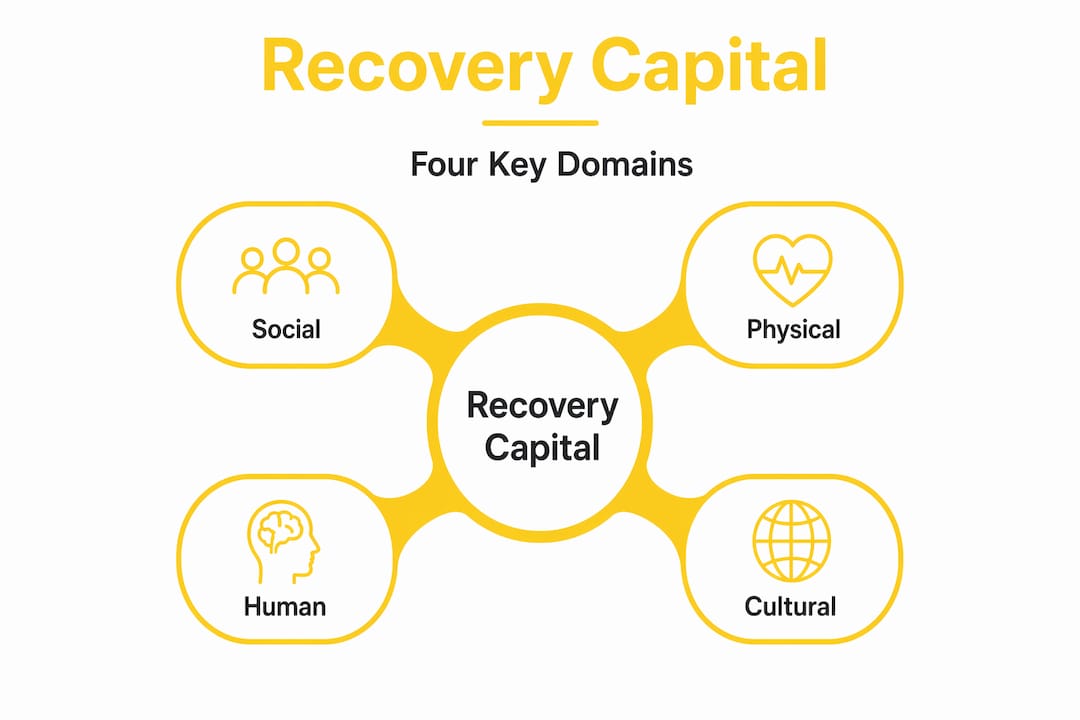
The framework organizes resources into four key domains:
- Social capital: The relationships, family connections, peer networks, and community ties that provide emotional support, accountability, and belonging.
- Physical capital: Tangible, material resources such as safe and stable housing, financial security, access to healthcare, and reliable transportation.
- Human capital: Personal skills, education, employment history, problem-solving abilities, coping strategies, and mental and physical health.
- Cultural capital: The values, beliefs, community identity, and sense of meaning that give recovery purpose and direction.
Each domain supports the others. Stable housing (physical capital) makes it easier to maintain employment (human capital), which deepens social confidence (social capital). When one domain weakens, others feel the strain.
Pro Tip: When you think about where to start building, pick the domain where you feel the least secure and identify one specific action. A single consistent step, like attending a weekly peer support group, compounds quickly across all four areas.
It is also worth understanding negative recovery capital. This refers to the barriers, not just the absences, that actively work against recovery. Stigma, poverty, and untreated mental health issues increase relapse risk significantly, and addressing them directly is as important as building positive resources.
Measuring recovery capital in research and practice
Knowing that recovery capital matters is one thing. Being able to measure it is what makes it genuinely useful in clinical settings and in your own self-assessment.
A 2025 systematic review confirmed that recovery capital functions as a biopsychosocial framework capable of identifying both strengths and barriers in addiction recovery. Researchers reviewed multiple measurement tools and found that most currently validated instruments focus on the individual level, with growing recognition that community-level measurement tools are needed as well.
Two of the most widely used instruments are:
- The Multidimensional Inventory of Recovery Capital (MIRC): A 28-item tool with a Cronbach’s alpha of .93, meaning it is highly reliable. A study of college students in recovery found that higher MIRC scores correlated with fewer mental health challenges, stronger relationships, and greater financial stability.
- The Recovery Capital Index (RCI): A validated, peer-reviewed tool that shifts the assessment focus from abstinence alone to broader wellbeing across personal, social, and cultural domains.
What these tools share is a practical orientation. They do not diagnose. They map. A clinician using the MIRC or RCI gets a clear picture of where a person stands across multiple domains, which allows for treatment planning that targets real gaps rather than applying a one-size-fits-all approach.
Pro Tip: You do not need a formal tool to start thinking in these terms. Write down three strengths you bring to your recovery and three areas where you feel most vulnerable. That informal map is the beginning of your own recovery capital assessment.
One important caution: many tools focus on individual-level resources and may not fully capture neighborhood conditions, community stigma, or systems-level barriers. Your experience is always broader than any checklist, and good clinicians know that.
How recovery capital shapes real recovery outcomes
Abstract frameworks only matter if they show up in real life. Recovery capital does, and the examples are more concrete than most people expect.

Think about what social capital looks like in practice. It is having one person in your life who picks up the phone at midnight. It is attending a peer recovery group where someone two years ahead of you normalizes what you are feeling. It is a sponsor, a sober friend, or a family member who does not treat your history as a permanent verdict on your character.
Physical capital looks like a front door that locks. It means not having to choose between paying for medication and buying groceries. It means getting a check-up without needing to explain your history to a stranger who might judge you. These are not luxuries in recovery. They are infrastructure.
“Recovery is shaped by everyday environments, relationships, and systems that either support or hinder progress, not just individual effort.” Research from the University of Calgary’s “recovering in place” model makes this explicit: where you live, who surrounds you, and what systems you can access shape recovery outcomes in ways that no amount of personal motivation can fully compensate for on its own.
Human capital shows up as the practical skills that make daily life manageable. Knowing how to regulate difficult emotions, how to communicate clearly in a job interview, how to build a daily structure that keeps idle hours from becoming dangerous hours. These skills are learnable. They are not fixed at birth, and they grow with practice and support.
Cultural capital is perhaps the least talked about, but it is deeply powerful. It is the sense that your life has meaning beyond staying sober. It might come from faith, from cultural identity, from being part of a recovery community that shares your values, or from a clear sense of purpose that makes the effort worthwhile.
You can read more about how support systems reinforce these domains for people in treatment.
How to build recovery capital: practical strategies
Building recovery capital is not one dramatic decision. It is a series of smaller, deliberate choices across each domain that add up over time. Here is how to approach each area with intention.
-
Assess honestly first. Before taking action, take stock. Where do you feel strong? Where do you feel most exposed? A counselor or treatment provider can help you map this formally, but an honest personal reflection is a real start.
-
Grow your social network deliberately. Attend peer support meetings regularly, not just when things feel urgent. Volunteer in your community. Reconnect with one person you trust. These connections accumulate into a safety net you cannot build in a crisis.
-
Stabilize your physical foundation. If housing is unstable, prioritize it. If you have not seen a doctor in years, make the appointment. If debt is constant background noise, look into financial counseling. Physical stability is not about wealth. It is about enough security to focus on recovery.
-
Invest in human capital through skills and mental health. Take a class. Work with a therapist. Practice one coping skill until it is automatic. Treat your mental health with the same seriousness you would a physical diagnosis, because it is one.
-
Identify what gives your recovery meaning. Cultural capital grows when you connect your recovery to something larger than not using. For some people, that is faith. For others, it is family, service, or creative work. Name what matters and protect time for it.
-
Revisit your map regularly. Recovery capital is not static. It changes with life circumstances. Check in every few months on where you feel stronger and where new vulnerabilities have appeared.
A good addiction treatment program will assess and address these domains as part of your care plan, not just monitor abstinence.
Common misconceptions about recovery capital
There are a few misunderstandings worth clearing up directly, because they can lead people to misapply this framework or dismiss it too quickly.
- Recovery capital is not the same as motivation. You can be deeply motivated and still have low recovery capital. The two are related but distinct. Motivation is internal. Recovery capital includes the full environment around you.
- More recovery capital does not guarantee recovery. It raises the probability of success and lowers the risk of relapse. It is a set of conditions, not a promise.
- Measurement tools are not one-size-fits-all. The systematic review findings make clear that individual-level tools are the current standard, but community-level dynamics matter too and are harder to capture.
- Recovery capital applies to everyone, not just people with severe addiction histories. It is useful for people managing mental health challenges, early recovery, long-term sobriety, and everything in between.
My perspective on why this framework changes everything
I have spent enough time working alongside people in recovery to say this clearly: the old model was broken. For too long, addiction treatment centered almost entirely on whether someone was using or not. That question matters, but treating it as the only question left people without real tools to sustain what they had built.
What I find compelling about the recovery capital framework is that it takes the full person seriously. In my experience, the people who struggle most are not lacking willpower. They are dealing with unstable housing, fractured relationships, untreated trauma, and community environments that offer no real alternative to substance use. When you address those conditions alongside the medical side of addiction, outcomes shift.
I also think the strength-based orientation matters psychologically. Asking “what do you already have?” is a fundamentally different conversation than “what have you lost?” The first one builds forward momentum. Addiction already strips people of dignity in enough ways. Treatment should not add to that.
The most effective work I have seen happens when clinicians integrate medication-assisted treatment with honest, domain-by-domain recovery capital assessment. Medication stabilizes the biology. The rest of the work builds the life that makes staying stable worth it.
— Cory
How Mdmatt supports your recovery capital
At Mdmatt, we believe that treating opioid use disorder means treating the whole person, not just the dependency. Our approach is built around the same principles that recovery capital research supports: address both the medical and life-context factors that shape sustainable recovery.
Medication-Assisted Treatment with Suboxone directly builds physical and human capital by stabilizing your health and freeing up cognitive and emotional bandwidth for everything else recovery requires. Our Suboxone treatment clinic in Maryland offers compassionate, patient-centered care designed around your specific situation. We also offer individual counseling to strengthen human and social capital, and telehealth services for patients who need flexibility. Reach out to Mdmatt today to talk through where you are and what a recovery capital-informed plan could look like for you.
FAQ
What is recovery capital in simple terms?
Recovery capital is the total collection of resources, both internal and external, that a person draws on to start and maintain recovery from addiction. It includes relationships, housing, skills, health, and personal values.
What are the four types of recovery capital?
The four domains are social capital (relationships and community), physical capital (housing, finances, healthcare), human capital (skills, mental health, education), and cultural capital (values, beliefs, and sense of meaning).
How is recovery capital measured?
Clinicians use validated tools like the MIRC and RCI to assess strengths and barriers across multiple life domains, going well beyond measuring abstinence alone.
Can recovery capital actually be built over time?
Yes. Recovery capital is dynamic, not fixed. Deliberate actions across social, physical, human, and cultural domains accumulate into a stronger recovery foundation, and collegiate recovery programs have demonstrated this clearly in structured settings.
What is negative recovery capital?
Negative recovery capital refers to barriers that actively undermine recovery, such as stigma, poverty, and untreated mental health conditions. Addressing these barriers is as important as building positive resources because they directly increase relapse risk.

