

Financial assistance for Suboxone treatment is available through manufacturer copay programs, Medicaid, Medicare, state grants, and community health clinics. Buprenorphine/naloxone, the active medication in Suboxone, is one of the most effective treatments for opioid use disorder, but the cost can be a real barrier. Without insurance, brand-name Suboxone can run $400 to $600 per month. The good news is that multiple programs exist specifically to close that gap, and you do not need to navigate them alone. This guide breaks down every major option, who qualifies, and how to apply.
What types of financial assistance are available for Suboxone treatment?
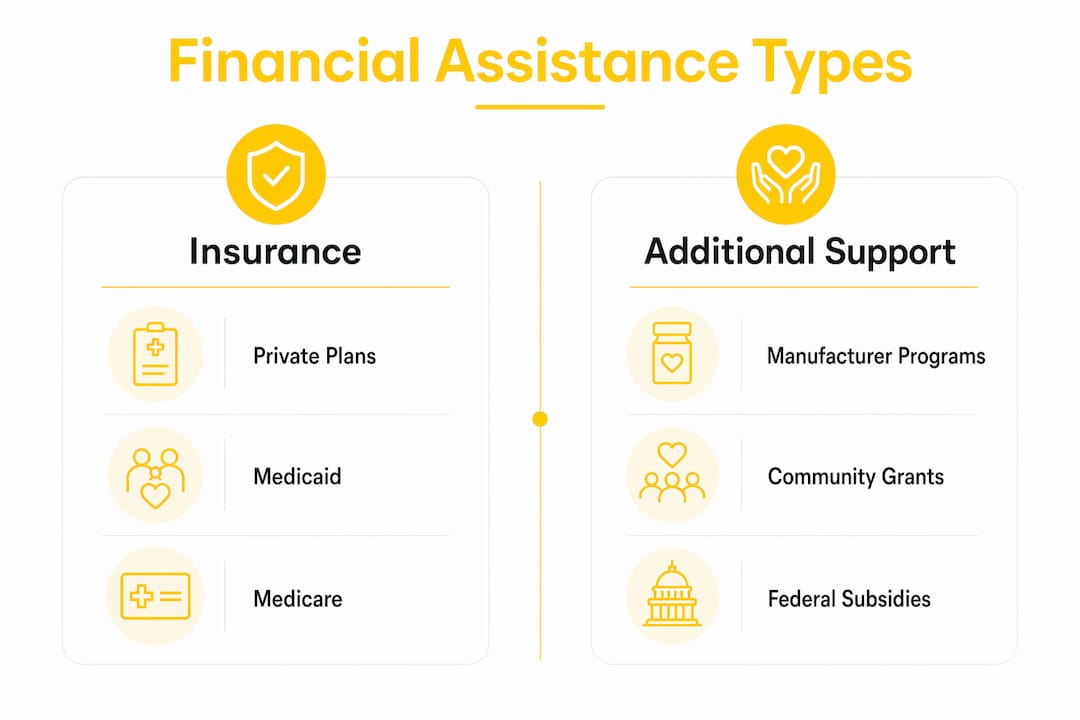
Financial help for Suboxone falls into four main categories: private insurance coverage, manufacturer savings programs, government-funded plans, and community-based resources. Knowing which category fits your situation is the fastest way to cut costs.
Private insurance and employer health plans are often the first place to check. Most major insurers cover buprenorphine/naloxone under their pharmacy benefit, though the copay tier and formulary placement vary. Some plans place brand-name Suboxone on a higher tier while covering generic buprenorphine/naloxone tablets at a lower cost. Checking your plan’s formulary online or calling the member services number takes about ten minutes and can save you hundreds of dollars per month.
Manufacturer copay assistance is the second major source of savings. The INSUPPORT program, offered by the maker of brand-name Suboxone, reduces monthly copays to as little as $5 for eligible privately insured patients. That figure represents a dramatic reduction for patients whose insurance places Suboxone on a high-cost tier.

Government-funded programs including Medicaid, Medicare, the VA, and TriCare cover Suboxone-related treatment for qualifying patients. Medicaid often covers all costs for substance abuse medications including buprenorphine/naloxone for eligible low-income individuals. Coverage scope varies by state, but for those who qualify, out-of-pocket costs can drop to zero.
Community resources and federal grants round out the options. The Substance Abuse Prevention and Treatment Block Grant, administered by SAMHSA, funds local treatment programs that offer Suboxone at low or no cost. Federally Qualified Health Centers (FQHCs) and nonprofit addiction clinics also provide sliding-scale fees based on income.
| Assistance type | Who qualifies | Typical coverage |
|---|---|---|
| Private insurance | Employed or individually insured | Partial to full medication cost |
| INSUPPORT copay card | Privately insured patients only | Up to $75 off copay per month |
| Medicaid | Low-income individuals meeting state criteria | Full medication and counseling costs |
| Medicare Part D | Adults 65+ or qualifying disabled | Partial coverage, varies by plan |
| SAMHSA block grants | Uninsured or underinsured patients | Low or no-cost treatment at clinics |
| Pharmacy discount cards | Anyone without active manufacturer card | Up to 90% off generic cost |
Pro Tip: Ask your prescribing provider whether generic buprenorphine/naloxone tablets are appropriate for your treatment plan. Generics combined with a free discount card from SingleCare or GoodRx can bring a 30-day supply to as low as $36 for uninsured patients.
How can you apply for and use manufacturer copay and savings programs?
The INSUPPORT program is the most direct manufacturer assistance available for brand-name Suboxone, and the application process is straightforward. Here is how to use it effectively.
-
Confirm your eligibility. The INSUPPORT copay card is available only to patients with private commercial insurance. It cannot be used with Medicaid, Medicare, VA benefits, or TriCare. Attempting to use it with a government plan results in a pharmacy rejection, which delays treatment. This is one of the most common and costly eligibility mistakes patients make.
-
Enroll online or through your provider. Visit the official Suboxone website or ask your prescribing physician to enroll you directly. New patients may receive their first two fills free, which provides immediate relief while you sort out longer-term coverage.
-
Bring the card to a participating pharmacy. Present the copay card at the pharmacy counter alongside your insurance card. The pharmacist processes both, and the program covers up to $75 off your copay per month. Your out-of-pocket cost can drop to as little as $5.
-
Track your monthly savings limit. The program covers a set dollar amount per month, not per fill. If your prescription is filled more than once in a billing cycle, confirm the remaining balance before the second fill.
-
Combine strategies for uninsured patients. If you do not have private insurance, manufacturer copay cards do not apply. Instead, use pharmacy discount cards like SingleCare alongside a generic prescription to minimize cost. You can only use one manufacturer savings offer at a time, but stacking a generic prescription with a pharmacy coupon is permitted.
Pro Tip: Do not wait until your prescription is at the pharmacy to sort out your savings card. Enroll in INSUPPORT before your first fill so the card is active and verified. A rejected card at the pharmacy counter can delay your first dose by days.
How does insurance coverage affect out-of-pocket costs for Suboxone?
Insurance coverage for Suboxone varies significantly depending on your plan type, formulary tier, and whether you use brand-name or generic medication. Understanding these variables helps you predict your real monthly cost before you fill a prescription.
Private insurance plans place medications on tiers. Brand-name Suboxone often lands on Tier 3 or Tier 4, which carries a higher copay than generics on Tier 1 or Tier 2. Switching to generic buprenorphine/naloxone tablets, when clinically appropriate, can reduce monthly costs from $400 to $600 down to $35 to $75 when combined with a discount program. That is a difference worth discussing with your provider.
Medicaid is the most comprehensive coverage option for qualifying patients. Beyond medication, Medicaid programs often cover counseling, medical visits, and integrated addiction support services. This makes Medication-Assisted Treatment genuinely affordable for low-income patients who meet state eligibility requirements. You can check eligibility through your state’s Medicaid portal or by calling your local Department of Social Services.
Medicare Part D covers buprenorphine/naloxone under prescription drug plans, but coverage levels vary by plan. Patients in the coverage gap, sometimes called the donut hole, may face higher costs temporarily. Reviewing your Part D plan’s formulary each year during open enrollment helps you choose the plan with the best coverage for your specific medications.
One critical rule applies across all government plans: manufacturer copay cards are prohibited for patients enrolled in Medicaid, Medicare, VA, or TriCare. Pharmacies are required to reject these cards when a government plan is active. If you are on a government plan, your path to savings runs through generic prescriptions, pharmacy discount cards, and community programs, not manufacturer assistance.
- Review your insurance formulary online before your first fill to confirm tier placement.
- Ask your pharmacy benefit manager whether prior authorization is required for Suboxone.
- Request a generic substitution if brand-name costs are prohibitive.
- Explore Medicaid eligibility if your income has changed recently.
Where can you find community resources and grants for Suboxone costs?
Community-based programs fill the gap for patients who do not qualify for Medicaid and cannot afford private insurance. These programs are more accessible than most people realize, and a social worker or patient navigator can connect you to them quickly.
SAMHSA’s Substance Abuse Prevention and Treatment Block Grant funds treatment programs in every state. These programs provide low or no-cost addiction treatment, including Suboxone prescriptions, at participating clinics. To find a funded clinic near you, use SAMHSA’s treatment locator at findtreatment.gov or call the National Helpline at 1-800-662-4357. Both services are free and confidential.
Federally Qualified Health Centers operate on a sliding-scale fee model, meaning your cost is based on your income. Many FQHCs have licensed addiction medicine providers on staff who can prescribe buprenorphine/naloxone. The Health Resources and Services Administration (HRSA) maintains a searchable directory of FQHCs at findahealthcenter.hrsa.gov.
Nonprofit organizations like the National Alliance on Mental Illness (NAMI) and local recovery community organizations sometimes offer emergency financial assistance or can connect you to grant-funded treatment slots. These resources are worth a phone call even if you are unsure whether you qualify.
- Contact your county’s Department of Health and Human Services to ask about local addiction treatment grants.
- Ask your treatment provider whether their clinic participates in any state-funded assistance programs.
- Check with hospital social workers if you have recently been treated for an overdose. Many hospitals have addiction medicine teams that can connect you to funded treatment.
Pro Tip: When calling any community program, ask specifically whether they have open slots funded by the Substance Abuse Prevention and Treatment Block Grant. Funded slots are often limited, and asking directly gets you a faster, more accurate answer than a general inquiry.
Key takeaways
Accessing affordable Suboxone treatment requires combining insurance coverage, manufacturer programs, generic substitutions, and community resources based on your specific eligibility.
| Point | Details |
|---|---|
| Manufacturer copay programs | INSUPPORT reduces brand-name Suboxone copays to as little as $5/month for privately insured patients. |
| Government plan restrictions | Medicaid and Medicare patients cannot use manufacturer copay cards; use generics and discount cards instead. |
| Generic cost savings | Generic buprenorphine/naloxone plus a discount card can cost as little as $36 per month for uninsured patients. |
| Medicaid coverage | Medicaid often covers medication, counseling, and medical visits at no cost for qualifying low-income patients. |
| Community grants | SAMHSA block grants fund low or no-cost treatment at local clinics accessible through findtreatment.gov. |
What I’ve learned about navigating financial barriers to Suboxone treatment
The single most common mistake I see is patients assuming they only have one option. Someone on Medicaid assumes they are covered and stops there, without realizing their state plan may require prior authorization or a specific generic formulation. Someone with private insurance assumes the copay card will work everywhere, then gets a rejection at the pharmacy because the card was not activated in advance.
The patients who manage costs most effectively treat financial assistance the same way they treat their treatment plan: they use multiple tools at once. They ask their provider about generics on day one. They check the formulary before the first fill. They call SAMHSA’s helpline if their insurance situation changes. They do not wait for a problem to appear before looking for a solution.
One thing I want to be direct about: cost should never be the reason someone delays starting Medication-Assisted Treatment. The support systems available for patients in recovery are more extensive than most people know going in. The financial assistance programs described in this article exist precisely because access to treatment saves lives. If you are facing a cost barrier right now, start with one phone call, whether that is to SAMHSA, your state Medicaid office, or a clinic like Mdmatt. One call opens more doors than most people expect.
— Cory
How Mdmatt supports affordable Suboxone treatment in Maryland
Mdmatt is a Maryland-based outpatient clinic specializing in Suboxone, Medication-Assisted Treatment, mental health, and addiction medicine. The team at Mdmatt understands that financial stress and opioid use disorder often arrive together, and they work with patients to identify the right coverage and assistance programs from the first appointment. Whether you have private insurance, Medicaid, or no coverage at all, Mdmatt’s providers can help you find a path to affordable treatment. Telehealth appointments are available, reducing travel costs and making it easier to stay consistent with your care. To learn more about Suboxone treatment options or to schedule a financial consultation, contact Mdmatt directly. You can also explore telehealth services if in-person visits are a barrier.
FAQ
What is the cheapest way to get Suboxone without insurance?
Generic buprenorphine/naloxone tablets combined with a free pharmacy discount card from SingleCare can cost as little as $36 for a 30-day supply. SAMHSA-funded community clinics also provide Suboxone at low or no cost for uninsured patients.
Can I use a Suboxone copay card with Medicaid?
No. Manufacturer copay cards like INSUPPORT are prohibited for patients enrolled in Medicaid, Medicare, VA, or TriCare. Using one with a government plan results in a pharmacy rejection. Medicaid patients should instead focus on generic prescriptions and state-funded programs.
How do I apply for financial assistance for Suboxone treatment?
Start by confirming your insurance status, then enroll in the INSUPPORT program if you have private insurance. If you are uninsured or on a government plan, call SAMHSA’s National Helpline at 1-800-662-4357 or use findtreatment.gov to locate a funded clinic near you.
Does Medicaid cover Suboxone treatment fully?
Medicaid often covers the full cost of buprenorphine/naloxone medication, counseling, and medical visits for qualifying patients, though coverage details vary by state. Checking your state’s Medicaid formulary or speaking with a patient navigator confirms exactly what is included in your plan.
Are there grants specifically for opioid addiction treatment?
Yes. The Substance Abuse Prevention and Treatment Block Grant, administered by SAMHSA, funds treatment programs across every state that provide low or no-cost Suboxone and addiction services. Eligibility and availability vary by location, so contacting your local health department is the fastest way to find open funded slots.

