

Buprenorphine is defined as a partial agonist at mu-opioid receptors, meaning it activates those receptors enough to prevent withdrawal and reduce cravings without producing the intense euphoria of a full opioid. This mechanism of action, known clinically as partial agonism, is what separates buprenorphine from drugs like heroin, fentanyl, and methadone. Understanding how buprenorphine works in the brain is not just academic. When you know what this medication is doing inside your nervous system, you can approach treatment with greater confidence and less fear. The science here is genuinely reassuring, and Mdmatt believes that informed patients make stronger, more committed partners in their own recovery.
How buprenorphine binds to opioid receptors in the brain
Buprenorphine’s power starts with one defining characteristic: its exceptionally high binding affinity at mu-opioid receptors. Compared to other opioids, buprenorphine binds to these receptors 1.7 times more strongly than hydromorphone, 5.4 times more strongly than morphine, 6.7 times more strongly than fentanyl, and a striking 120 times more strongly than oxycodone. That level of receptor preference means buprenorphine physically outcompetes other opioids for the same binding sites. This is why it can displace active opioids from receptors and why it works so effectively as a treatment medication.
Once bound, buprenorphine does not fully activate the mu-opioid receptor. It produces a partial response, which is the defining feature of its pharmacology. PET imaging studies show that a 2 mg dose occupies 41% of mu-opioid receptors, a 16 mg dose reaches 80% occupancy, and a 32 mg dose reaches only 84%. The plateau between 16 mg and 32 mg is critical. It demonstrates that increasing the dose beyond a certain point produces diminishing returns on receptor activation, which is exactly what limits euphoria and overdose risk.

Buprenorphine also acts as an antagonist at kappa and delta opioid receptors, meaning it blocks those receptors rather than activating them. This is a detail many patients and even some providers overlook. Kappa receptor blockade, in particular, has meaningful implications for mood and emotional stability during recovery, which is covered in a later section.
Because buprenorphine is highly lipophilic, it crosses the blood-brain barrier rapidly after administration. This fast central nervous system penetration explains why patients typically notice relief from withdrawal symptoms within 30 to 60 minutes of their first dose.
Key receptor binding facts at a glance:
| Receptor type | Buprenorphine’s action | Clinical result |
|---|---|---|
| Mu-opioid receptor | Partial agonist | Reduces withdrawal and cravings without full euphoria |
| Kappa-opioid receptor | Antagonist | Reduces dysphoria and stress-related relapse triggers |
| Delta-opioid receptor | Antagonist | Modulates mood and pain signaling |
- Buprenorphine’s receptor occupancy plateaus at higher doses, creating a natural ceiling on its opioid effects.
- Its superior binding affinity allows it to displace full agonists like fentanyl from receptors.
- Partial activation means the brain receives a stabilizing signal rather than a flood of opioid activity.
Pro Tip: If you are starting buprenorphine, your prescriber will ask you to be in mild to moderate withdrawal before your first dose. This is not to make you suffer. It is to prevent precipitated withdrawal, which happens when buprenorphine displaces a full agonist that is still heavily occupying your receptors.
What buprenorphine does to your brain chemistry
The neurochemical effects of buprenorphine go well beyond simply occupying receptors. When buprenorphine partially activates mu-opioid receptors, it stabilizes brain dopamine levels in the reward pathways of the brain, particularly in the nucleus accumbens and ventral tegmental area. Dopamine is the neurotransmitter most associated with reward, motivation, and craving. Full opioids flood these pathways with dopamine, creating intense highs followed by sharp crashes. Buprenorphine produces a steady, moderate dopamine signal instead.
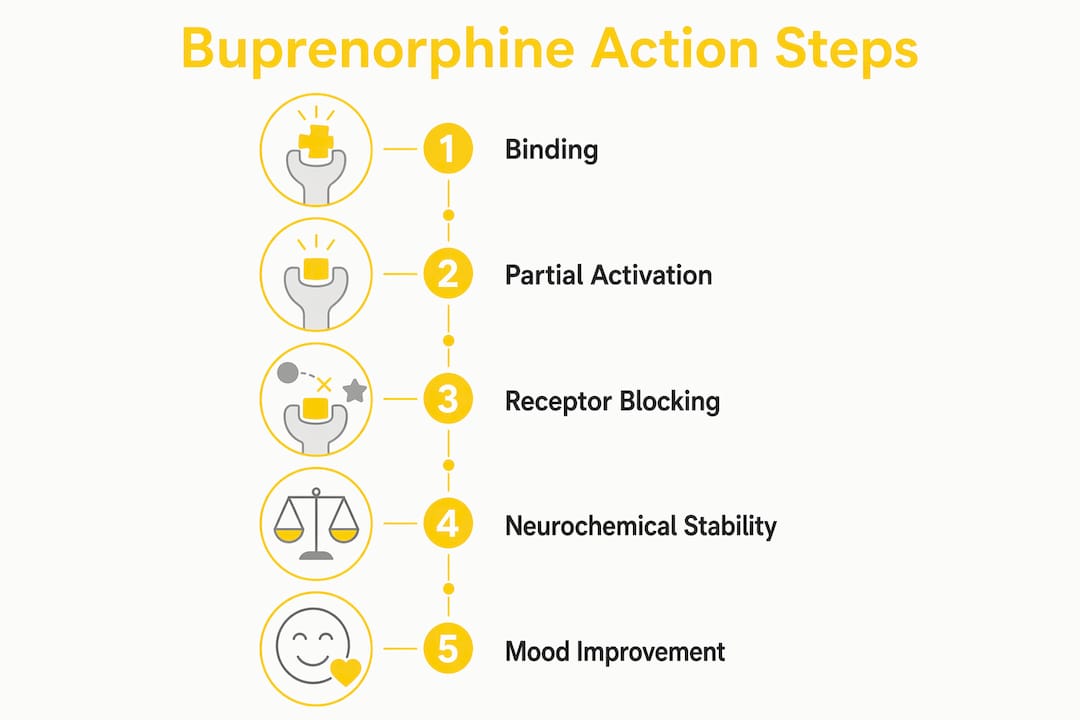
This steady signal is what makes the difference between craving and calm. When your brain is not swinging between dopamine floods and dopamine deficits, the compulsive drive to seek opioids diminishes significantly. Patients often describe this as feeling “normal” for the first time in a long time, and that description maps directly onto what is happening neurochemically.
Buprenorphine’s half-life of 24 to 48 hours is another major neurochemical advantage. Because the medication stays active in your system for so long, receptor occupancy remains steady throughout the day and night. There are no troughs where receptors go unoccupied and withdrawal symptoms creep back in. This steady receptor engagement prevents the cycles of intoxication and withdrawal that disrupt brain reward pathways and make recovery so difficult without medication.
- Dopamine stabilization reduces the neurological urgency behind cravings.
- Steady receptor occupancy eliminates the withdrawal-craving cycle that drives relapse.
- The long half-life supports once-daily or even alternate-day dosing, which simplifies treatment adherence.
- Neurobiological stabilization allows the prefrontal cortex, the brain’s decision-making center, to regain influence over behavior.
Pro Tip: The long half-life of buprenorphine is one of its most underappreciated advantages. If you miss a dose by a few hours, your brain chemistry does not crash the way it would with a short-acting opioid. This built-in buffer makes treatment far more forgiving and sustainable in real life.
How buprenorphine compares to full opioid agonists
Understanding how buprenorphine differs from heroin, fentanyl, and methadone clarifies why it is the preferred first-line medication for opioid use disorder in most clinical settings. The most important difference is the ceiling effect on respiratory depression. Full agonists like heroin and fentanyl continue to suppress breathing in direct proportion to the dose. Buprenorphine’s partial agonism means that beyond a certain dose, respiratory depression does not increase further. This ceiling effect is why buprenorphine overdose deaths are far less common than those involving full agonists.
The comparison with methadone is also worth understanding. Methadone is a full mu-opioid agonist with a long half-life, which means it carries a higher overdose risk than buprenorphine, particularly in the early days of treatment when tolerance is being established. Buprenorphine’s partial agonism provides a similar duration of action with a substantially safer pharmacological profile.
- Euphoria ceiling. Full agonists produce escalating euphoria with increasing doses. Buprenorphine’s euphoric effect plateaus, which reduces the motivation to misuse the medication.
- Respiratory safety. Buprenorphine’s ceiling on respiratory depression makes accidental overdose far less likely than with fentanyl or heroin.
- Receptor displacement. Buprenorphine’s superior affinity means it can block the effects of other opioids taken on top of it, supporting behavioral adherence to treatment.
- Precipitated withdrawal risk. Because buprenorphine displaces full agonists, taking it too soon after a full agonist causes sudden, intense withdrawal. This is a clinical consideration, not a reason to avoid the medication.
| Feature | Buprenorphine | Full agonists (heroin, fentanyl) | Methadone |
|---|---|---|---|
| Receptor activation | Partial | Full | Full |
| Euphoria ceiling | Yes | No | No |
| Overdose risk | Lower | High | Moderate to high |
| Half-life | 24 to 48 hours | Minutes to hours | 24 to 36 hours |
| Blocks other opioids | Yes | No | Partial |
You can read more about partial agonist activity and what it means for your treatment at Mdmatt’s resource library.
How buprenorphine affects mood and mental health
The psychological effects of buprenorphine extend well beyond addiction control, and this is one of the most clinically significant aspects of how buprenorphine affects neurotransmitters. Kappa-opioid receptor antagonism is the mechanism responsible. Kappa receptors, when activated, produce dysphoria, anxiety, and a stress response that feels deeply unpleasant. By blocking these receptors, buprenorphine reduces dysphoria and stress-induced relapse triggers, which is a meaningful neurobiological advantage over medications that do not act on kappa receptors.
This matters enormously for patients who carry a dual diagnosis. The co-occurrence of major depressive disorder and opioid use disorder is well documented, and buprenorphine’s potential antidepressant effects make it particularly valuable for this population. Many patients report that their mood lifts noticeably within the first few weeks of treatment, and this is not simply relief from withdrawal. It reflects genuine neurobiological stabilization at the kappa receptor level.
For individuals dealing with co-occurring addiction and mental health conditions, understanding this dual mechanism can be genuinely hopeful. Buprenorphine is not just managing a physical dependency. It is actively working on the emotional and psychological dimensions of opioid use disorder at the same time.
- Kappa receptor blockade reduces the emotional pain and stress that often trigger relapse.
- Mood stabilization during early recovery supports engagement with counseling and therapy.
- Patients with depression alongside opioid use disorder may experience compounded benefits from buprenorphine treatment.
- Sustained emotional stability increases treatment retention, which is one of the strongest predictors of long-term recovery success.
Key takeaways
Buprenorphine works by partially activating mu-opioid receptors and blocking kappa and delta receptors, stabilizing brain chemistry to reduce withdrawal, cravings, and dysphoria without producing a full opioid high.
| Point | Details |
|---|---|
| Partial mu-opioid agonism | Activates receptors enough to prevent withdrawal without causing intense euphoria. |
| Receptor occupancy plateau | Doses above 16 mg produce minimal additional receptor activation, limiting overdose risk. |
| Dopamine stabilization | Steady receptor engagement normalizes dopamine signaling and reduces compulsive craving. |
| Kappa receptor blockade | Reduces dysphoria and stress-related relapse triggers, supporting mood during recovery. |
| Long half-life advantage | 24 to 48 hour duration prevents withdrawal troughs and supports consistent daily functioning. |
What I’ve learned from watching patients understand their own treatment
When patients come to Mdmatt and I explain what buprenorphine is actually doing inside their brain, something shifts. The fear of being “on another drug” starts to dissolve when they understand that buprenorphine is not flooding their receptors. It is steadying them. That distinction matters deeply to people who have spent years feeling out of control.
The precipitated withdrawal concern is the one that deserves the most honest conversation. I have seen patients delay starting treatment because they are afraid of that experience. The truth is that with proper clinical guidance and a clear induction protocol, precipitated withdrawal is avoidable. The careful timing of your first dose is something your provider manages with you, not something you face alone.
What surprises patients most is the mood piece. They expect the physical withdrawal symptoms to ease. They do not always expect to feel emotionally lighter within a few weeks. When that happens, it reinforces that recovery is not just about stopping opioid use. It is about restoring a brain that has been under enormous stress. Buprenorphine’s kappa receptor antagonism is doing real work there, and patients deserve to know it. Understanding the long-term effects of Suboxone helps set realistic expectations and builds the kind of trust that keeps people in treatment when things get hard.
— Cory
Start your recovery with expert buprenorphine care

Mdmatt’s Suboxone treatment clinic provides personalized, medically supervised buprenorphine treatment designed around your specific needs. Because buprenorphine’s long half-life supports flexible dosing schedules, treatment fits into your real life rather than demanding that your life fit around treatment. Every patient at Mdmatt receives access to medication management alongside counseling support, because addressing the root causes of opioid use disorder matters just as much as managing the physical dependence. If you are ready to take the first step, or if you simply want to talk through your options, Mdmatt’s team is here to meet you with dignity, patience, and genuine expertise. Telehealth treatment services are also available for those who prefer to begin care from home.
FAQ
What is buprenorphine used for?
Buprenorphine is used primarily to treat opioid use disorder as part of Medication-Assisted Treatment (MAT). It reduces withdrawal symptoms and cravings by partially activating mu-opioid receptors in the brain.
How does buprenorphine bind to receptors differently than heroin?
Buprenorphine binds to mu-opioid receptors with up to 120 times greater affinity than some full agonists, but only partially activates them. Heroin fully activates these receptors, producing intense euphoria and a much higher overdose risk.
Can buprenorphine cause withdrawal if taken too soon?
Yes. Because buprenorphine displaces full agonists from receptors, taking it while a full opioid is still heavily active can cause precipitated withdrawal. Your prescriber will time your first dose carefully to prevent this.
Does buprenorphine affect mood as well as physical withdrawal?
Buprenorphine’s antagonism at kappa-opioid receptors reduces dysphoria and stress-related symptoms, which often improves mood during early recovery. Research supports its potential antidepressant effects in patients with co-occurring depression and opioid use disorder.
How long does buprenorphine stay active in the brain?
Buprenorphine has a half-life of 24 to 48 hours, which means it maintains steady receptor occupancy throughout the day. This prevents the withdrawal troughs that drive cravings and supports consistent daily functioning.

