

Stopping Suboxone suddenly is defined clinically as abrupt buprenorphine/naloxone cessation, and it carries serious, well-documented risks that go far beyond temporary discomfort. The primary dangers are opioid withdrawal, rapid loss of receptor protection, and a sharply elevated risk of relapse and fatal overdose. Understanding why abrupt Suboxone stop is dangerous is not just reassuring. It is the first step toward making a safer, more informed decision about your treatment. Medical guidelines from the FDA and Mayo Clinic are clear: physical dependence from chronic buprenorphine use means the body cannot simply stop without consequences, and a supervised taper is the only evidence-based path forward.
Why does stopping Suboxone abruptly cause withdrawal?
Suboxone contains buprenorphine, a partial mu-opioid receptor agonist, and naloxone, an opioid antagonist. When you take Suboxone consistently over weeks or months, your nervous system adapts to its presence. That adaptation is called physical dependence, and it is not the same as addiction. It simply means your body has recalibrated around the medication.
Physical dependence triggers withdrawal when any opioid medication is stopped suddenly, because the nervous system loses the chemical signal it has come to rely on. Think of it like suddenly removing a support beam from a structure that has been built around it. The structure does not collapse instantly, but it becomes unstable quickly.

What makes buprenorphine unique is its long pharmacologic half-life, which means plasma concentrations fall slowly over days or even weeks after the last dose. This delays the onset of withdrawal symptoms, which can mislead people into thinking they are fine. Then, several days later, symptoms escalate sharply.
Buprenorphine also binds to opioid receptors with high affinity and partial agonist effects, creating a ceiling effect that protects against overdose during treatment. When that binding disappears abruptly, receptors are left without stimulation, triggering a rebound response. This is distinct from precipitated withdrawal, which happens at induction when buprenorphine displaces a full agonist. You can read more about that distinction in this guide on avoiding precipitated withdrawal.
Pro Tip: If you have taken Suboxone for more than a few weeks, do not judge your withdrawal risk by how you feel in the first 24 to 48 hours after stopping. Buprenorphine’s long half-life means symptoms often peak between days 3 and 7.
Key pharmacologic facts to understand:
- Buprenorphine’s half-life ranges from 24 to 42 hours, far longer than most opioids
- Withdrawal onset after abrupt cessation is typically delayed by 2 to 4 days
- Symptoms can persist for weeks due to slow receptor dissociation
- The delay creates a false sense of safety that increases the risk of stopping without medical support
What are the real dangers of stopping Suboxone suddenly?
The risks of abrupt suboxone cessation fall into three categories: physical withdrawal, psychological destabilization, and life-threatening relapse.
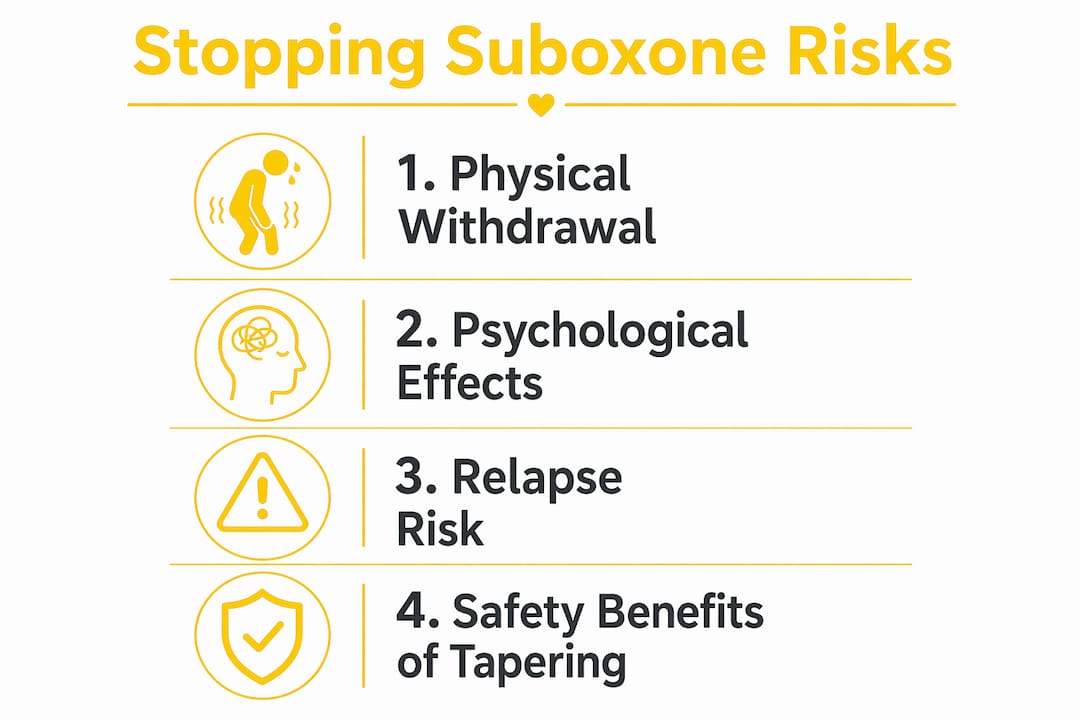
On the physical side, withdrawal symptoms include anxiety, fever, nausea, sweating, tremors, and insomnia. These are not trivial. Severe nausea and sweating can cause dehydration, and insomnia combined with anxiety creates a mental state that makes resisting cravings nearly impossible.
The psychological dimension is where the real danger compounds. When buprenorphine leaves your system, the receptor blockade it provided disappears with it. Your tolerance to opioids drops significantly within days. If you relapse at that point and use the same dose you used before starting Suboxone, the risk of overdose is dramatically higher because your body can no longer handle what it once could. The FDA package insert explicitly warns that abrupt treatment discontinuation increases opioid overdose risk due to loss of buprenorphine’s protective effects.
The mortality data is sobering. A 2026 analysis published in PLOS Mental Health found that over 55% of patients discontinue buprenorphine within 6 months, and discontinuation is associated with increased overdose mortality, suicide risk, and all-cause mortality. That means stopping treatment is one of the most dangerous moments in opioid use disorder recovery, not a sign of progress if done without a plan.
“The main clinical danger of stopping Suboxone abruptly is not immediate medical collapse. It is the relapse that follows when tolerance drops and receptor protection disappears.”
Understanding how Suboxone actively prevents relapse during treatment makes it clearer why removing it suddenly leaves you exposed.
| Risk | What it means for you |
|---|---|
| Physical withdrawal | Symptoms like nausea, sweating, and insomnia peak days after stopping, not immediately |
| Loss of receptor blockade | Opioid cravings return without the protective buffer buprenorphine provides |
| Reduced tolerance | A relapse dose that felt normal before treatment can now cause fatal overdose |
| Elevated mortality | Discontinuation within 6 months is linked to higher overdose and all-cause death rates |
Why is tapering Suboxone safer than stopping abruptly?
Tapering means reducing your Suboxone dose gradually over weeks or months rather than stopping all at once. The clinical rationale is straightforward: a slow reduction gives your nervous system time to re-equilibrate, rebuilding its own regulatory capacity without the shock of sudden withdrawal.
FDA labeling states that discontinuation of buprenorphine/naloxone should be part of a comprehensive treatment plan that includes tapering and counseling to address relapse risk. This is not a suggestion. It is the standard of care.
Here is how a medically supervised taper typically works:
- Establish a baseline dose. Your prescriber confirms your current stable dose before any reduction begins.
- Reduce in small increments. Most protocols reduce by 2 mg every 1 to 4 weeks, depending on how long you have been on treatment and how your body responds.
- Monitor symptoms at each step. If withdrawal symptoms appear, the taper slows or pauses. Rushing this process defeats its purpose.
- Use fractional film reductions. Suboxone films can be cut to allow reductions smaller than standard tablet doses, giving more precise control.
- Integrate counseling throughout. Behavioral support during a taper addresses the psychological drivers of cravings that medication alone cannot resolve.
Gradual tapering allows the nervous system to re-equilibrate and prevents the abrupt receptor deactivation that triggers severe withdrawal and relapse-driven overdose deaths. The slower the taper, the lower the withdrawal severity at each step.
Pro Tip: There is no universal taper timeline. Someone who has been on Suboxone for 5 years needs a different plan than someone who has been on it for 6 months. Work with your prescriber to build a schedule that fits your history, not a generic template.
For a broader picture of what long-term Suboxone use involves, the article on Suboxone long-term effects offers useful context before making any discontinuation decision.
What practical steps can you take to stop Suboxone safely?
Stopping Suboxone safely requires preparation, not willpower. The following steps reflect current clinical best practices for suboxone treatment discontinuation.
- Talk to your prescriber before changing anything. Do not reduce your dose on your own. Your doctor or nurse practitioner can assess your readiness, build a taper schedule, and identify risk factors specific to your situation.
- Track your symptoms daily. Keep a simple log of sleep quality, cravings, anxiety, and physical symptoms. This gives your provider the data they need to adjust your taper pace.
- Know the warning signs that require immediate contact. If cravings become overwhelming, withdrawal symptoms escalate beyond mild discomfort, or you feel at risk of using, contact your prescriber the same day. The FDA recommends that patients have rapid re-access to their prescriber to manage emergent withdrawal or cravings during and after discontinuation.
- Build a post-cessation support plan. Recovery does not end when Suboxone does. Plan for continued counseling, peer support groups, and regular follow-up appointments for at least 6 months after your final dose.
- Address mental health alongside the taper. Anxiety, depression, and trauma are common drivers of opioid use disorder. Stopping Suboxone without addressing these factors significantly raises relapse risk.
The effects of stopping Suboxone suddenly are most dangerous when there is no plan in place. Preparation transforms a high-risk moment into a managed transition.
Key takeaways
Abrupt Suboxone cessation is dangerous primarily because it triggers delayed withdrawal, eliminates receptor protection, and raises overdose risk during relapse, making a supervised taper the only safe path to discontinuation.
| Point | Details |
|---|---|
| Delayed withdrawal onset | Buprenorphine’s long half-life means symptoms peak days after stopping, not immediately. |
| Relapse is the primary danger | Loss of receptor blockade and falling tolerance make any relapse dose potentially fatal. |
| Over 55% discontinue too soon | Most patients stop within 6 months, the highest-risk window for overdose and mortality. |
| Tapering reduces all major risks | Gradual dose reduction allows nervous system re-equilibration and lowers withdrawal severity. |
| Medical supervision is non-negotiable | FDA guidelines require tapering and counseling as part of any discontinuation plan. |
What most people get wrong about stopping Suboxone
People often assume that the danger of stopping Suboxone suddenly is the withdrawal itself. That assumption leads to a dangerous miscalculation.
Withdrawal from buprenorphine is rarely immediately life-threatening in the way that alcohol or benzodiazepine withdrawal can be. What makes abrupt cessation so dangerous is what comes after the withdrawal: the relapse. When tolerance drops and receptor protection disappears, a person who returns to opioid use is doing so with a body that no longer has the defenses it once had. That is when overdoses happen.
I have also seen people underestimate the delay. They stop Suboxone, feel okay for two or three days, and conclude they are through the worst of it. Then day four or five arrives and symptoms escalate hard. That delayed escalation catches people off guard and often pushes them toward using just to feel normal again.
The other misconception I want to address directly: stopping Suboxone is not a milestone in recovery. Staying well is the milestone. For some people, long-term maintenance is the right clinical choice, and there is no shame in that. For others, a carefully planned taper at the right time in recovery is appropriate. What is never appropriate is quitting too fast without support, because the data on what happens next is not ambiguous.
If you are considering stopping, the most protective thing you can do is not rely on willpower. Build a plan, involve your provider, and treat the transition with the same seriousness you gave to starting treatment.
— Cory
How Mdmatt supports safe Suboxone tapering

At Mdmatt, we understand that deciding to stop Suboxone is a significant moment in your recovery, and you deserve expert support to do it safely. Our team of addiction medicine providers builds individualized taper plans based on your history, current dose, and personal goals. We do not use one-size-fits-all protocols because your recovery is not one-size-fits-all.
We offer both in-person and telehealth treatment services so you can access care from wherever you are most comfortable. Every taper plan at Mdmatt is paired with counseling and mental health support, because we know that the root causes of opioid use disorder need attention alongside the medication itself. Visit our Suboxone treatment clinic page to learn more and take the next step with a team that treats you with the dignity and care you deserve.
FAQ
What happens when you stop Suboxone suddenly?
Stopping Suboxone suddenly triggers opioid withdrawal due to physical dependence, with symptoms including anxiety, nausea, sweating, tremors, and insomnia. Because of buprenorphine’s long half-life, these symptoms are often delayed by 2 to 4 days and can intensify over the following week.
Why is skipping a Suboxone dose dangerous?
Skipping doses disrupts the stable blood concentration that keeps withdrawal symptoms suppressed and cravings controlled. Even one missed dose can allow withdrawal symptoms to begin, increasing the urge to use other opioids.
How long does Suboxone withdrawal last after stopping?
Withdrawal from Suboxone typically begins 2 to 4 days after the last dose and can last 2 to 4 weeks or longer, depending on how long you were on treatment and your dose at the time of stopping. A supervised taper significantly shortens and reduces the severity of this timeline.
Is tapering Suboxone always necessary before stopping?
Yes. FDA labeling states that discontinuation of buprenorphine/naloxone should include a gradual taper as part of a comprehensive treatment plan. Abrupt cessation without tapering increases withdrawal severity, relapse risk, and overdose mortality.
Can you stop Suboxone on your own without a doctor?
Stopping without medical supervision is not recommended. The risks of abrupt suboxone cessation include severe withdrawal, rapid tolerance loss, and elevated overdose risk during any relapse. A prescriber can build a taper schedule that makes the process far safer and more manageable.

