Outpatient treatment is defined as structured medical and therapeutic care delivered without overnight hospital admission, allowing patients to attend scheduled sessions and return home the same day. This model covers a wide range of services, from individual therapy and group counseling to medication management and psychiatric care. Programs like Intensive Outpatient Programs (IOPs) and standard outpatient therapy give patients real flexibility in how they receive care. Telehealth has expanded access further, letting patients connect with clinicians from home. For anyone managing opioid use disorder or a mental health condition, understanding how outpatient treatment works is the first step toward choosing the right path forward.
How does outpatient treatment work? The process from intake to completion
The outpatient treatment process begins with a clinical assessment. A licensed clinician evaluates your medical history, substance use patterns, mental health status, and daily life circumstances. That evaluation determines which level of care fits your needs and whether outpatient care is clinically appropriate for you.
Outpatient programs range from weekly individual therapy sessions to Intensive Outpatient Programs (IOPs) that meet multiple times per week for several hours per session. IOPs typically include structured group therapy, one-on-one psychotherapy, and medication management spread across multiple weeks. High-Intensity Outpatient Programs (HIOPs) add another layer of support for patients who need more structure without full inpatient admission.
Here is a typical progression through outpatient care:
- Initial assessment. A clinician reviews your health history and substance use to determine the right program level.
- Program placement. You are placed in standard outpatient, IOP, or HIOP based on clinical need and personal circumstances.
- Therapy sessions begin. Individual, group, and family therapy sessions are scheduled according to your program type.
- Medication management. For opioid use disorder, Medication-Assisted Treatment with Suboxone may be prescribed and monitored by a physician.
- Progress monitoring. Clinicians track your progress regularly and adjust the treatment plan as needed.
- Step-down or completion. As you stabilize, session frequency decreases until you transition to aftercare or maintenance care.
Outpatient treatment requires higher patient motivation and personal stability than inpatient care. You are managing recovery while navigating real-life responsibilities at home and at work. That challenge is also one of its greatest strengths: the skills you build in treatment apply directly to your daily life.
Pro Tip: Before your first appointment, write down your top three daily stressors. Sharing these with your clinician during intake helps shape a treatment plan that addresses the root causes of your condition, not just the symptoms.

What are the benefits and challenges of outpatient vs. inpatient care?
Outpatient care offers meaningful cost savings. Patients can save up to 40% compared to inpatient treatment by avoiding hospital overhead costs. That difference matters significantly for patients managing treatment over months or years.
The psychological benefits are equally significant. Recovering in a familiar environment helps patients form lasting habits and avoid the institutionalization effects that can follow extended inpatient stays. Staying connected to your home, your relationships, and your work preserves the social and professional identity that acts as a protective factor against relapse.
Key benefits of outpatient care:
- Lower cost compared to inpatient programs
- Flexibility to maintain work, school, and family responsibilities
- Real-world skill building during active treatment
- Insurance often covers outpatient addiction treatment, though coverage details vary by plan
- Telehealth options reduce transportation barriers
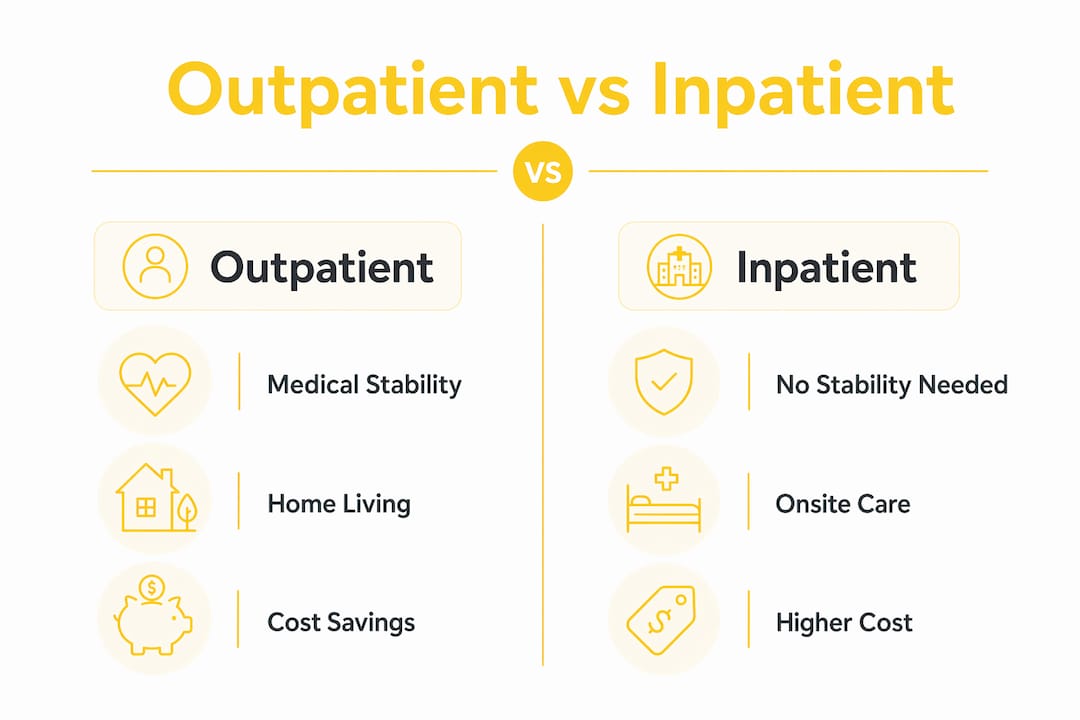
Outpatient care is not the right fit for every situation. Patients experiencing severe withdrawal, active suicidal ideation, or an unstable home environment typically need inpatient care first. The table below clarifies when each level of care is most appropriate.
| Factor | Outpatient care | Inpatient care |
|---|---|---|
| Medical stability | Required | Not required |
| Living environment | Stable and supportive | Can be unstable |
| Supervision level | Scheduled sessions only | 24-hour monitoring |
| Cost | Lower | Higher |
| Daily life continuity | Maintained | Interrupted |
| Severity of condition | Mild to moderate | Moderate to severe |
One common misconception is that group therapy requires you to share personal details publicly. Therapists clarify that listening and offering support are equally valid forms of participation. You set the pace of your own disclosure.
Pro Tip: Contact your insurance provider before your first appointment and ask specifically about outpatient behavioral health benefits. Many plans cover IOPs and medication management, but pre-authorization may be required.
How does telehealth improve access to outpatient care?
Telehealth has become a standard feature of outpatient treatment, not an exception. About 60% of outpatient patients currently use telehealth options to improve access and flexibility. At programs like Nebraska Medicine’s intensive outpatient program, telehealth participation helps patients balance work schedules, transportation challenges, and family obligations.
The benefits of telehealth in outpatient care are concrete:
- Eliminates commute time and transportation costs
- Allows family members to join sessions from their own location
- Reduces missed appointments caused by scheduling conflicts
- Supports patients in rural or underserved areas with limited local providers
- Enables flexible mental health care for patients with demanding work schedules
Research supports telehealth’s clinical value. Teletherapy produces outcomes comparable to in-person therapy for many mental health and substance use conditions. That finding has encouraged more outpatient programs to offer hybrid models combining in-person and virtual sessions.
“Telehealth in outpatient addiction treatment increases access for those balancing work, transportation, and family obligations, making recovery a realistic option for more people.” — Nebraska Medicine
Not every patient is a strong candidate for fully virtual care. Patients who need hands-on medication monitoring, urine drug screening, or in-person psychiatric evaluation still require some in-person visits. Mdmatt’s telehealth treatment services are designed to blend virtual and in-person care based on each patient’s clinical needs.
What should patients expect during outpatient treatment?
Outpatient sessions vary in length and format depending on your program type. Standard outpatient therapy sessions typically run 45–60 minutes. IOP sessions often run 2–3 hours and include a combination of group therapy, psychoeducation, and individual check-ins.
Here is what a typical week in an IOP looks like:
- Group therapy session. A clinician leads a structured discussion on a recovery-related topic such as coping skills, triggers, or communication.
- Individual therapy. A one-on-one session with your assigned therapist to address personal goals and challenges.
- Medication check-in. If you are on Suboxone or another medication, your prescribing physician reviews your response and adjusts dosing as needed.
- Skill-building activity. Practical exercises like stress management techniques or relapse prevention planning.
- Progress review. Your care team evaluates your progress and updates your treatment plan.
Outpatient treatment builds skills in real-life contexts. You practice what you learn in sessions immediately, in the same environment where your challenges exist. That real-world application is something inpatient care cannot replicate in the same way. Reviewing the full addiction recovery timeline can help you understand where outpatient care fits within the broader treatment process.
Support networks matter throughout treatment. Your peers in group therapy, your family, and your clinical team all play active roles. Family therapy sessions, when available, help loved ones understand your condition and learn how to support your recovery without enabling harmful patterns.
Pro Tip: Attend every scheduled session for the first four weeks, even when you feel well. Consistency in early treatment builds the therapeutic relationship and clinical trust that makes later, harder conversations possible.
Key takeaways
Outpatient treatment delivers structured, evidence-based care for mental health and substance use disorders without requiring a hospital stay, making it the most accessible and cost-effective path to recovery for clinically stable patients.
| Point | Details |
|---|---|
| Defined care without admission | Outpatient treatment provides therapy and medication management without overnight hospital stays. |
| Multiple program levels | IOPs and HIOPs offer structured intensity for patients who need more than weekly therapy. |
| Cost and flexibility advantage | Outpatient care can save patients up to 40% compared to inpatient treatment. |
| Telehealth expands access | About 60% of outpatient patients use telehealth to manage scheduling and transportation barriers. |
| Motivation is required | Success in outpatient care depends on patient stability, personal responsibility, and consistent attendance. |
Outpatient care has changed what recovery looks like
The patients I see who do best in outpatient treatment share one trait: they want to stay connected to their lives. They are not looking to step away from their family, their job, or their community. They want to get better without losing everything they are working to protect.
That is exactly what outpatient care is designed for. But I want to be honest about something most articles skip over. Outpatient treatment is harder in one specific way than inpatient care. You go home after every session. The triggers, the stress, the difficult relationships are all still there. You do not get a controlled environment to recover in. You recover in the real world, in real time.
That is also why it works so well for long-term recovery. The habits you build in treatment are built inside the same life you are trying to improve. There is no adjustment period when you leave. You are already living it.
Telehealth has made this model even more accessible. Patients who once could not attend because of transportation, childcare, or work schedules can now participate fully. That shift has opened outpatient care to people who previously had no realistic path to treatment.
Safety protocols and care coordination between outpatient and inpatient settings have also improved significantly. Patients who need a higher level of care can be escalated quickly. That coordination matters. Outpatient care is not a lesser option. It is a different and often better option for the right patient.
— Cory
Outpatient treatment programs at Mdmatt
Mdmatt provides outpatient addiction treatment and psychiatric care designed around your real life, not a hospital schedule.
Mdmatt offers Suboxone-based Medication-Assisted Treatment for opioid use disorder, intensive outpatient programs, individual counseling, and telehealth sessions for patients across Maryland. The clinical team treats the whole person, addressing the root causes of addiction alongside the medical condition itself. Whether you are ready to start treatment or still weighing your options, Mdmatt’s addiction treatment services include a full clinical assessment to match you with the right level of care. Reach out to schedule your evaluation and take the first step at your own pace.
FAQ
What is outpatient treatment used for?
Outpatient treatment is used for mental health conditions, substance use disorders including opioid use disorder, and co-occurring diagnoses. It delivers therapy, psychiatric care, and medication management without requiring a hospital stay.
How long does outpatient treatment last?
Duration varies by program type and individual progress. Standard outpatient therapy may continue for months, while IOPs typically run 8–12 weeks with multiple sessions per week.
Is outpatient treatment effective for opioid use disorder?
Outpatient treatment is clinically effective for opioid use disorder, especially when combined with Medication-Assisted Treatment using Suboxone. Effective outpatient programs coordinate therapy and medication under physician supervision to support sustained recovery.
Do I have to share personal details in group therapy?
No. Listening and offering support are fully accepted forms of participation in group therapy. You control the pace and depth of your own disclosure throughout the process.
Does insurance cover outpatient addiction treatment?
Insurance frequently covers outpatient addiction treatment, including IOPs and medication management. Coverage details vary by plan, so contacting your insurer before starting treatment to confirm benefits and pre-authorization requirements is the right first step.