Outpatient psychiatric care is mental health treatment delivered in a clinical setting where patients live at home and attend scheduled sessions for therapy and medication management. Unlike inpatient hospitalization, this model lets you keep your job, your family routine, and your daily life intact while still receiving professional mental health support. Conditions treated include depression, anxiety, trauma, opioid use disorder, and psychotic disorders. Most major PPO and HMO insurance plans cover outpatient psychiatric services when clinically appropriate, making this one of the most accessible forms of mental health care available.
What is outpatient psychiatric care and what services does it include?
Outpatient psychiatric care, also called ambulatory mental health treatment, covers a wide range of therapeutic and medical services delivered without overnight hospitalization. The core components are individual psychotherapy, group therapy, medication management, and peer support groups. A psychiatrist or licensed clinician evaluates your needs and builds a personalized treatment plan from those components.

Treatment intensity is clinically determined, not patient preference. Intensive Outpatient Programs (IOP) require 9–20 hours per week of clinical contact. Standard outpatient care involves fewer than 9 hours weekly. That distinction matters because it shapes how much your daily schedule is affected and how quickly you stabilize.
Evidence-based therapies anchor most outpatient programs. Cognitive Behavioral Therapy (CBT) teaches you to identify and reframe distorted thought patterns. Dialectical Behavior Therapy (DBT) builds emotional regulation and distress tolerance skills. Both are widely practiced in outpatient settings and have strong clinical track records for conditions like depression, anxiety, and borderline personality disorder.
- Individual therapy: One-on-one sessions with a licensed therapist or psychiatrist, typically 45–60 minutes
- Group therapy: Structured sessions with peers facing similar challenges, building social support and shared coping strategies
- Medication management: Regular psychiatric appointments to prescribe, monitor, and adjust medications
- Intensive Outpatient Programs: Structured multi-hour programs for patients needing more support than weekly therapy alone
- Telehealth options: Virtual psychiatric sessions that expand access for patients with transportation or scheduling barriers
Pro Tip: If you are unsure which intensity level fits your needs, ask your clinician for a formal assessment. Starting at the right tier prevents both under-treatment and unnecessary disruption to your daily life.
How does outpatient care compare to inpatient treatment?
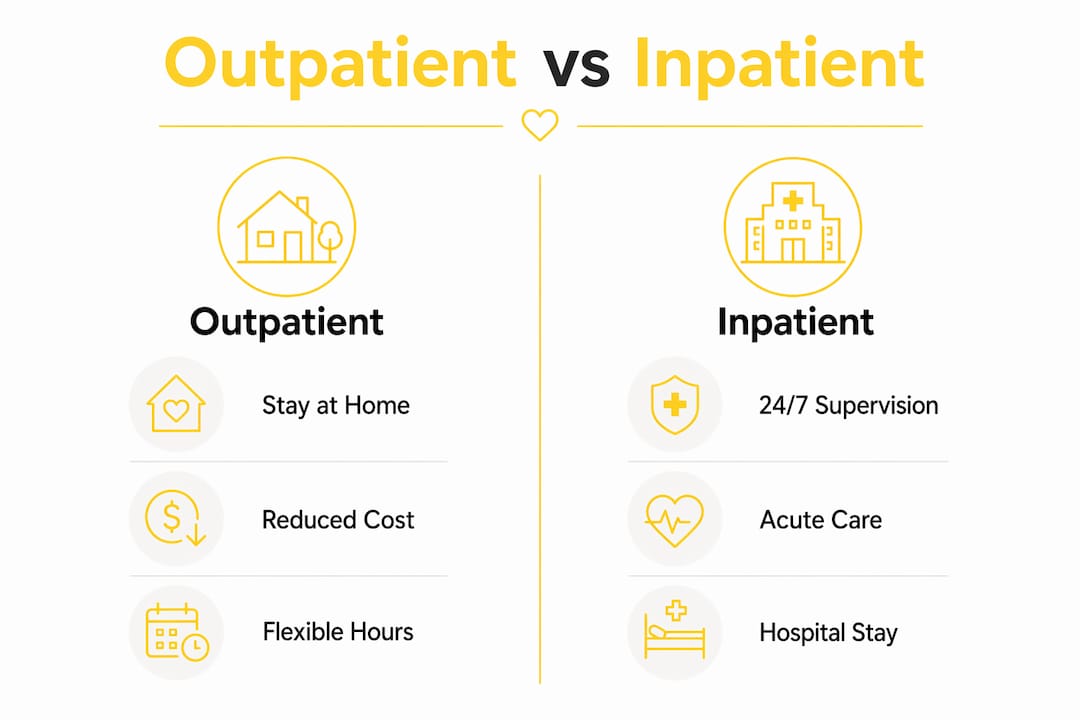
The core difference is supervision. Inpatient psychiatric care places you in a hospital or residential facility with 24/7 clinical oversight. Outpatient mental health treatment lets you return home after each session. That single distinction drives most of the differences in cost, autonomy, and clinical fit.
Outpatient care reduces treatment costs by up to 40% compared to inpatient care by eliminating hospital room and board fees. For patients managing long-term conditions like depression or opioid use disorder, that savings compounds significantly over months of treatment.
The tradeoff is supervision. Inpatient care suits patients in acute crisis, those with active suicidal ideation, or those whose home environment is unsafe. Outpatient care suits patients who are medically stable, have a reliable support system, and can commit to attending scheduled sessions. Clinicians use structured admission criteria to determine which setting is appropriate.
| Factor | Outpatient care | Inpatient care |
|---|---|---|
| Living situation | Patient stays at home | Patient stays at facility |
| Supervision level | Scheduled sessions only | 24/7 clinical oversight |
| Cost | Up to 40% lower | Higher due to room and board |
| Daily routine | Largely maintained | Fully disrupted |
| Best suited for | Stable patients with support | Acute crisis or safety risk |
| Flexibility | High | Low |
Pro Tip: Outpatient care is not a lesser version of inpatient care. For many patients, practicing coping skills in their actual home environment produces better long-term results than a controlled clinical setting.
What are the main benefits of outpatient psychiatric care?
The most significant benefit is real-world integration. Outpatient care enables patients to practice coping mechanisms in their everyday environment, which enhances habit change and long-term recovery. A therapy skill practiced at home, at work, or in a relationship carries more weight than one practiced only in a clinical room.
Flexibility is the second major advantage. Outpatient programs allow patients to continue working, attending school, and managing family responsibilities. This matters enormously for people who cannot afford to pause their lives for weeks of residential treatment.
The benefits extend beyond scheduling. Consider what outpatient psychiatric services offer in practical terms:
- Financial accessibility: Lower out-of-pocket costs and broad insurance coverage make treatment sustainable over time
- Autonomy: You make decisions about your daily life while receiving clinical guidance
- Continuity: Long-term outpatient relationships with a consistent clinician build trust and treatment depth
- Community connection: Staying embedded in your social network supports recovery rather than isolating you from it
- Skill application: Therapeutic techniques get tested in real situations, not just role-played in sessions
The challenges are real too. Outpatient care requires self-motivation. You will not have a nurse checking on you between sessions. Patients who struggle with severe symptoms, unstable housing, or active substance use crises may need a higher level of care before transitioning to outpatient treatment. Understanding when outpatient treatment fits your situation is as important as understanding its benefits.
A strong support system is one of the most critical factors in preventing relapse and ensuring successful outpatient psychiatric treatment. Clinicians consistently identify social support as the variable that separates patients who sustain gains from those who relapse. If your support network is thin, building it is part of the treatment plan.
How does outpatient therapy work in practice?
Understanding the structure of outpatient care removes a lot of the anxiety around starting. Here is how a typical outpatient psychiatric program operates from intake to ongoing care:
- Initial evaluation: A psychiatrist or licensed clinician conducts a comprehensive assessment covering your mental health history, current symptoms, medications, and social situation. This determines your diagnosis and appropriate intensity level.
- Treatment plan development: Your clinician builds a written plan specifying session frequency, therapy modalities, medication protocols, and measurable goals. You review and agree to this plan together.
- Scheduled sessions: Depending on your tier, you attend individual therapy, group sessions, or medication management appointments on a set weekly schedule. Standard outpatient typically means one to two sessions per week.
- Between-session practice: Your therapist assigns exercises, journaling prompts, or behavioral experiments to complete between appointments. This is where real change happens. Applying coping strategies in your daily environment is the mechanism that drives lasting improvement.
- Progress monitoring: Your clinician reviews your progress at regular intervals, typically every four to six weeks, and adjusts the treatment plan based on outcomes. Medication dosages, therapy focus, and session frequency all get recalibrated as needed.
- Telehealth integration: Many outpatient programs now offer virtual session options for therapy and medication management. Telehealth expands access and improves continuity, especially for patients with transportation barriers or demanding work schedules.
Coordination between your therapist and prescribing psychiatrist is a core feature of quality outpatient care. When both providers share notes and align on your treatment goals, you get consistent messaging and fewer gaps in care. Ask your program directly how their clinical team communicates.
Choosing the right type of support, whether therapy, medication management, or a combination, depends on your specific situation. A resource like this guide on therapy and support options can help you think through what fits before your first appointment.
Key Takeaways
Outpatient psychiatric care is the most cost-effective and flexible form of mental health treatment for stable patients, requiring strong personal commitment and a reliable support system to succeed.
| Point | Details |
|---|---|
| Core definition | Scheduled therapy and medication management without overnight hospitalization |
| Cost advantage | Outpatient care costs up to 40% less than inpatient by eliminating room and board fees |
| Intensity tiers | IOPs require 9–20 hours weekly; standard outpatient requires fewer than 9 hours |
| Success factor | A strong support system is the single most critical variable in outpatient treatment outcomes |
| Real-world practice | Applying coping skills in your home environment drives more lasting change than clinical-only practice |
Why outpatient care deserves more credit than it gets
Most people assume that more intensive treatment automatically means better treatment. That assumption is wrong, and I have seen it steer patients toward inpatient programs they did not need, at a cost and disruption they could not afford.
Outpatient psychiatric care works precisely because it does not remove you from your life. The hard work of recovery, managing a difficult relationship, holding down a job while managing anxiety, resisting a craving in a familiar environment, happens outside the therapist’s office. Outpatient treatment puts the skills where they need to be used.
What I have found is that patients who struggle in outpatient care usually lack one of two things: a stable home environment or a genuine support network. Those are solvable problems. A good outpatient program addresses both directly, through safety planning, family involvement, and peer support groups. The role of support systems in outpatient success is not a soft consideration. It is a clinical one.
My advice to anyone weighing their options: do not default to the most intensive level of care out of fear. Get a proper clinical assessment. Ask your provider to explain exactly why a given intensity level fits your situation. Outpatient care, done right, is not the easy option. It is often the most effective one.
— Cory
Outpatient psychiatric and addiction care at Mdmatt
Mdmatt is an outpatient psychiatric and addiction treatment practice built around one principle: treating patients with dignity produces better outcomes. Every treatment plan is personalized, whether you need individual counseling, medication management, or a combination of both.

Mdmatt offers Suboxone and Medication-Assisted Treatment for opioid use disorder, integrated with psychiatric support to address the root causes of addiction. Telehealth services are available for patients who need flexible scheduling or remote access. If you are ready to understand which level of outpatient care fits your situation, contact Mdmatt for a clinical assessment. The right support is closer than you think.
FAQ
What is outpatient psychiatric care used to treat?
Outpatient psychiatric care treats conditions including depression, anxiety disorders, trauma, PTSD, bipolar disorder, opioid use disorder, and psychotic disorders. Treatment is appropriate when symptoms are manageable without 24/7 supervision.
How many hours per week does outpatient treatment require?
Standard outpatient care requires fewer than 9 hours of clinical contact per week. Intensive Outpatient Programs require 9–20 hours weekly, depending on clinical need.
Is outpatient psychiatric care covered by insurance?
Most major PPO and HMO insurance plans cover outpatient psychiatric services when deemed clinically reasonable and necessary. Verify your specific benefits with your insurer before starting a program.
Who is not a good candidate for outpatient mental health treatment?
Patients in acute psychiatric crisis, those with active suicidal ideation, or those without a stable home environment typically require inpatient or residential care before stepping down to outpatient treatment.
Does telehealth count as outpatient psychiatric care?
Yes. Telehealth therapy and medication management sessions are a recognized form of outpatient psychiatric care. Virtual options improve access and continuity without changing the clinical standards of treatment.