Stigma is defined as a set of negative beliefs and social judgments that mark a person as less worthy of care, and it is one of the most powerful barriers to addiction treatment in the United States. Understanding addiction stigma matters because it does not just hurt feelings. It causes people to hide their substance use from doctors, avoid treatment entirely, and drop out of care they desperately need. Research published in 2026 confirms that nearly half of adults with substance use disorders do not disclose their use to healthcare providers because of stigma. If you or someone you love is struggling with opioid use disorder, knowing how stigma influences treatment is the first step toward getting past it.
How stigma affects addiction treatment: the three types you need to know
Stigma acts at multiple levels, and each type works differently. Recognizing them helps you understand why treatment can feel so hard to access.
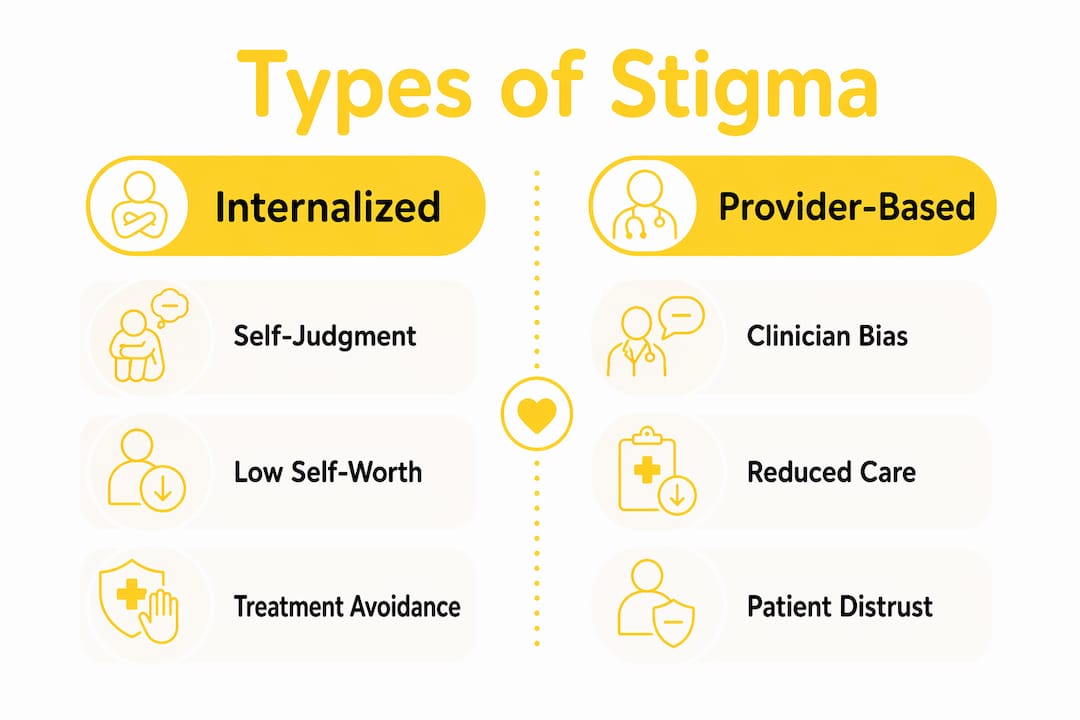
Internalized stigma is what happens when a person absorbs society’s negative messages and starts to believe them about themselves. Research shows that internalized stigma reduces self-esteem and creates what researchers call a “spoiled identity,” where a person sees their addiction as their whole self rather than a medical condition they are living with. This damages long-term recovery by making goals feel unreachable.

Public stigma comes from the community, media, and social networks. It shows up as moral judgment, negative stereotypes, and the widespread belief that addiction is a character flaw rather than a chronic brain disease. Public stigma shapes how family members respond, how employers treat people in recovery, and how society funds treatment programs.
Structural stigma is built into systems and policies. It appears in insurance coverage gaps, limited treatment facility availability, and laws that restrict access to medications like Suboxone. Structural stigma is often invisible but consistently harmful.
- Internalized stigma: shame, low self-worth, the “why try” effect
- Public stigma: social rejection, discrimination, moral judgment
- Structural stigma: policy barriers, funding gaps, restricted medication access
- Provider-based stigma: clinician bias that lowers care quality and therapeutic trust
Pro Tip: If you notice you are avoiding treatment because you feel you “don’t deserve” help, that is internalized stigma speaking. It is a symptom of the disease, not a fact about your worth.
Provider-based stigma deserves its own category. When clinicians hold negative attitudes toward patients with addiction, it leads to poorer therapeutic relationships, higher burnout among providers, and lower acceptance of harm reduction approaches. The relationship between clinician stigma and care quality runs in both directions: poor care reinforces patient distrust, and patient distrust makes care harder to deliver.
How does clinician stigma shape treatment decisions?
The data on clinician stigma is striking. A 2026 survey of 1,240 clinicians, including primary care physicians, emergency physicians, and dentists, found that more than 30% prefer not to work with patients who have opioid or stimulant use disorders. That level of stigma is higher than what clinicians report toward patients with depression, diabetes, or HIV. The implication is serious: the very professionals people turn to for help are, in many cases, predisposed to provide lower-quality care.
The consequences for patients are measurable. A 2026 mixed-methods study of 119 inpatients found that 49.6% did not disclose substance use to their healthcare providers because of stigma. Beyond non-disclosure, 36.1% avoided necessary medical treatment altogether, and 29.4% discontinued care they had already started. These are not small numbers. They represent a treatment gap driven not by lack of motivation but by fear of judgment.
| Behavior caused by stigma | Rate among patients |
|---|---|
| Non-disclosure of substance use to providers | 49.6% |
| Avoidance of necessary medical treatment | 36.1% |
| Discontinuation of ongoing medical care | 29.4% |
Clinicians with less training in evidence-based addiction treatments tend to hold more stigmatizing attitudes, which reinforces a cycle of poor care. Undertrained providers stigmatize patients. Stigmatized patients disengage. Disengaged patients confirm the provider’s bias. Breaking this cycle requires targeted clinician education, not just patient resilience.
Pro Tip: If a provider makes you feel judged, that reaction often reflects their lack of training rather than a personal judgment of you. Seeking a second opinion or a specialized addiction medicine provider is a reasonable and healthy response.
Can stigma affect treatment engagement differently at each stage of recovery?
Stigma does not hit every stage of recovery with equal force. The evidence suggests it is a much stronger barrier to starting treatment than to staying in it once you are enrolled in a supportive program.
A 2026 study of 97 participants in low-threshold buprenorphine programs found that high perceived stigma does not necessarily lower engagement at 30 days of treatment. That finding is counterintuitive and important. It means that once a person enters a program designed around dignity and low barriers, stigma loses much of its power to push them out. The design of the program matters enormously.
One of the most surprising findings from that same research: patients who had previously been denied medical care for substance use were sometimes more persistent in engaging with patient-centered programs. Having lower expectations of traditional healthcare systems, they were more willing to commit to programs that treated them with respect. Discrimination, in some cases, built a kind of selective resilience.
What this means for you or your loved one:
- Stigma is most dangerous before treatment begins, when shame and fear prevent the first call or appointment
- Once inside a low-threshold, patient-centered program, retention is achievable even with high perceived stigma
- Medication-Assisted Treatment (MAT) programs using buprenorphine, including Suboxone, are among the most studied low-threshold options
- Choosing a provider who specializes in addiction medicine reduces exposure to stigmatizing attitudes from the start
The full recovery timeline from detox through aftercare shows how stigma can resurface at different points. Knowing where it tends to appear helps you prepare for it.
How do language and social narratives reinforce stigma?
Words carry weight in addiction care. Referring to someone as an “addict” or a “junkie” activates moral judgment in listeners and damages self-image in the person being labeled. The clinical standard now favors person-first language: “a person with opioid use disorder” rather than “an opioid addict.” This shift is not political correctness. It reflects the disease model of addiction, which is supported by decades of neuroscience research.
Social narratives compound the problem. When media portrayals frame addiction as a moral failure or a lifestyle choice, public stigma grows. That stigma then filters into families, workplaces, and healthcare settings. People with opioid use disorder absorb these messages and internalize them, feeding the “why try” effect that targeted counseling focused on self-efficacy is specifically designed to counter.
Recovery definitions also carry stigma. When recovery is defined solely as total abstinence, it excludes people who are reducing harm, stabilizing on medication, or rebuilding their lives while still using substances at lower levels. Recovery experts now recommend broader, inclusive recovery definitions that center personal growth, improved functioning, and reduced harm rather than a single endpoint.
“Defining recovery as abstinence-only can increase stigma and exclude people who still use substances from the support services they need most.”
The Suboxone stigma guide at Mdmatt addresses this directly, offering practical ways to reframe medication use as treatment rather than weakness.
What practical steps reduce stigma and improve treatment access?
Reducing stigma requires action at three levels: individual, clinical, and community. Each level has specific, evidence-based moves that make a real difference.
- For patients and families: Use person-first language when talking about addiction. Replace “addict” with “person with a substance use disorder.” This small shift changes how you think about the condition and how others respond to it.
- For patients facing stigmatizing providers: Recognize that clinician stigma often reflects burnout or lack of training, not a personal verdict on you. Seek out addiction medicine specialists or outpatient programs built around patient-centered care.
- For clinicians: Prioritize education on the disease model of addiction and evidence-based treatments like Medication-Assisted Treatment. Clinician education on the disease model is the single most effective tool for reducing provider stigma.
- For communities: Advocate for inclusive recovery definitions that go beyond abstinence. Support funding for low-threshold programs. Challenge stigmatizing language in media and public conversation.
- For anyone supporting a loved one: Learn about recovery capital, the internal and external resources that support long-term recovery. Stigma erodes recovery capital. Building it back requires active, consistent support.
Pro Tip: If internalized stigma is making recovery feel pointless, ask your treatment provider specifically about self-efficacy counseling. Targeted therapy that rebuilds your sense of agency is one of the most effective tools against the “why try” effect.
Addressing common misconceptions about MAT is also a practical step. Many people avoid Suboxone or buprenorphine because of myths that label it as “trading one addiction for another.” That framing is stigma, not science.
Key takeaways
Stigma is the single most documented non-financial barrier to addiction treatment, and addressing it at the individual, clinical, and community level is the most direct path to closing the treatment gap.
| Point | Details |
|---|---|
| Stigma blocks treatment entry | Nearly half of patients hide substance use from providers due to fear of judgment. |
| Clinician stigma is measurable | Over 30% of surveyed US clinicians prefer not to treat opioid or stimulant use disorders. |
| Retention is achievable | High perceived stigma does not significantly reduce 30-day retention in low-threshold programs. |
| Language shapes outcomes | Person-first language and broader recovery definitions reduce internalized and public stigma. |
| Education breaks the cycle | Clinician training in evidence-based addiction treatment is the most effective way to reduce provider stigma. |
Stigma in addiction care: what the research is finally making clear
I have watched the conversation around addiction stigma shift over the past several years, and the 2026 research confirms what many patients already knew from lived experience. Stigma is not a soft, feelings-based concern. It is a clinical variable that predicts whether someone gets care, stays in care, and recovers.
What strikes me most is the clinician data. When more than 30% of surveyed physicians would rather not treat patients with opioid use disorder, we are not dealing with a few bad actors. We are dealing with a systemic training failure. Medical education has historically underemphasized addiction medicine, and that gap produces providers who are uncomfortable, undertrained, and, as a result, stigmatizing. The solution is not to shame those clinicians. It is to train them.
For patients and families reading this: you are not imagining it when a provider makes you feel like a burden. That experience is real and documented. And it is not a reason to give up on treatment. It is a reason to find a provider who specializes in this work and approaches it with the respect it deserves. Stigma-aware care exists. Seeking it out is not weakness. It is good judgment.
— Cory
Compassionate addiction care at Mdmatt
Mdmatt is an outpatient addiction treatment practice built on the belief that dignity and kindness are not optional extras in care. They are the foundation of effective treatment. The team at Mdmatt specializes in Suboxone and Medication-Assisted Treatment for opioid use disorder, with a patient-centered approach that addresses not just the addiction but the life circumstances that contributed to it. Telehealth appointments are available for patients who prefer to start care from home, and clinic locations serve patients across Maryland. If stigma has kept you or someone you love from getting help, Mdmatt offers a place where that changes. Reach out to schedule an appointment.
FAQ
What is stigma in addiction treatment?
Stigma in addiction treatment refers to negative beliefs, judgments, and attitudes toward people with substance use disorders that discourage them from seeking or continuing care. It operates at the individual, provider, and systemic level.
Does stigma from doctors affect addiction recovery?
Yes. A 2026 survey found that more than 30% of US clinicians prefer not to treat patients with opioid or stimulant use disorders, leading to lower care quality, reduced disclosure, and higher rates of treatment avoidance among patients.
Can someone stay in treatment even if they feel stigmatized?
Research on low-threshold buprenorphine programs shows that high perceived stigma does not necessarily reduce 30-day treatment retention. Patient-centered program design significantly reduces stigma’s power to push people out of care.
How does internalized stigma affect recovery?
Internalized stigma creates a “why try” effect, where low self-worth makes recovery feel futile. Targeted counseling focused on building self-efficacy is the most effective clinical response to this barrier.
What language reduces stigma around addiction?
Person-first language, such as “person with opioid use disorder” rather than “addict,” reduces moral judgment and supports the disease model of addiction. Broader recovery definitions that include harm reduction and personal growth also lower stigma.